Supermassive Black Hole
A black hole with a mass ranging from millions to billions of times that of the Sun, typically found at the centers of galaxies. These black holes influence the dynamics and evolution of their host galaxies.
Source: nasa.gov
APODs including "Supermassive Black Hole"
Elliptical Galaxy M87
20/05/2006
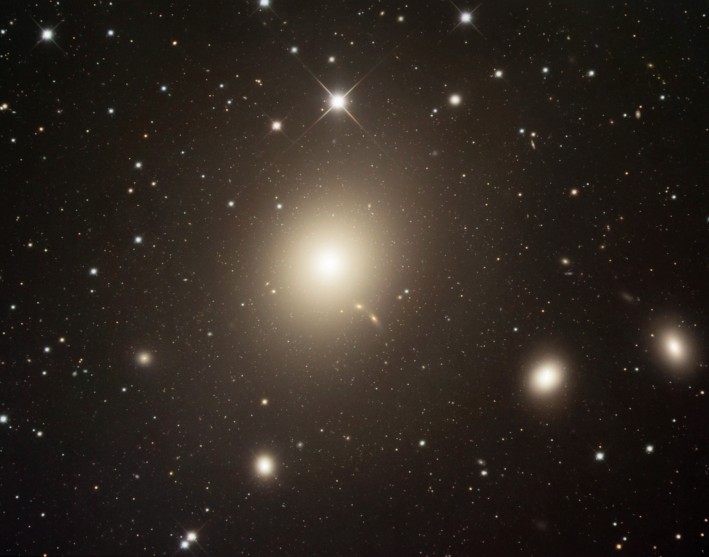
In spiral galaxies, majestic winding arms of young stars and interstellar gas and dust rotate in a flat disk around a bulging galactic nucleus. But elliptical galaxies seem to be simpler. Lacking gas and dust to form new stars, their randomly swarming older stars, give them an ellipsoidal (egg-like) shape. Still, elliptical galaxies can be very large. Over 120,000 light-years in diameter (larger than our own Milky Way), elliptical galaxy M87 is the dominant galaxy at the center of the Virgo Galaxy Cluster, some 50 million light-years away. M87 is likely home to a supermassive black hole responsible for the high-energy jet of particles emerging from the giant galaxy's central region.