Supermassive Black Hole
A black hole with a mass ranging from millions to billions of times that of the Sun, typically found at the centers of galaxies. These black holes influence the dynamics and evolution of their host galaxies.
Source: nasa.gov
APODs including "Supermassive Black Hole"
At Last, GLAST
13/06/2008
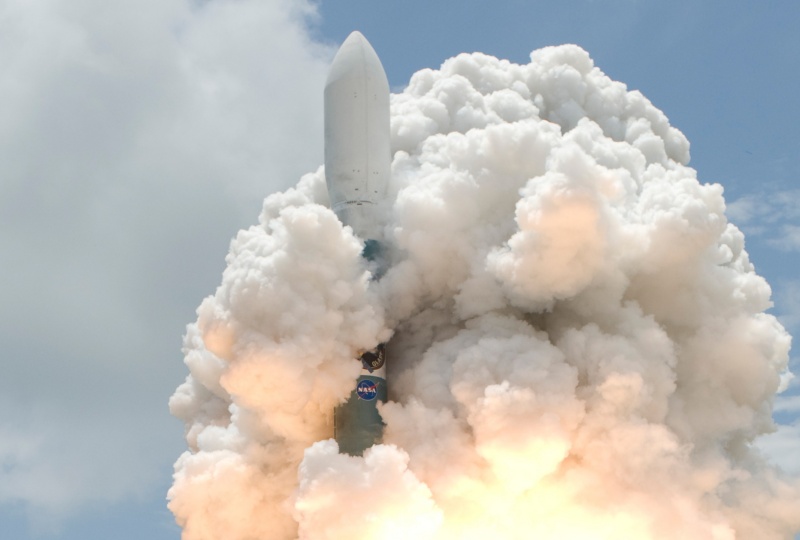
Rising through a billowing cloud of smoke, this Delta II rocket left Cape Canaveral Air Force Station's launch pad 17-B Wednesday at 12:05 pm EDT. Snug in the payload section was GLAST, the Gamma-ray Large Area Space Telescope, now in orbit around planet Earth. GLAST's detector technology was developed for use in terrestrial particle accelerators. But from orbit, GLAST can study gamma-rays from extreme environments in our own Milky Way galaxy, as well as supermassive black holes at the centers of distant active galaxies, and the sources of powerful gamma-ray bursts. Those cosmic accelerators achieve energies not attainable in earthbound laboratories. GLAST also has the sensitivity to search for signatures of new physics in the relatively unexplored high-energy gamma-ray regime.