Supermassive Black Hole
A black hole with a mass ranging from millions to billions of times that of the Sun, typically found at the centers of galaxies. These black holes influence the dynamics and evolution of their host galaxies.
Source: nasa.gov
APODs including "Supermassive Black Hole"
Arp 299: Black Holes in Colliding Galaxies
01/11/2016
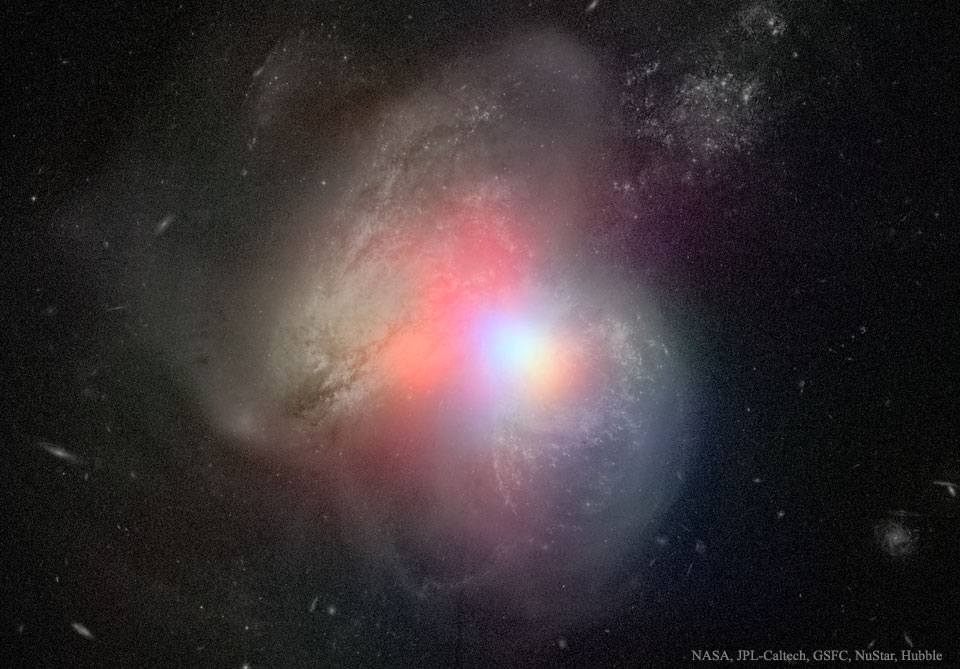
Is only one black hole spewing high energy radiation -- or two? To help find out, astronomers trained NASA's Earth-orbiting NuSTAR and Chandra telescopes on Arp 299, the enigmatic colliding galaxies expelling the radiation. The two galaxies of Arp 299 have been locked in a gravitational combat for millions of years, while their central black holes will soon do battle themselves. Featured, the high-resolution visible-light image was taken by Hubble, while the superposed diffuse glow of X-ray light was imaged by NuSTAR and shown in false-color red, green, and blue. NuSTAR observations show that only one of the central black holes is seen fighting its way through a region of gas and dust -- and so absorbing matter and emitting X-rays. The energetic radiation, coming only from the galaxy center on the right, is surely created nearby -- but outside -- the central black hole's event horizon. In a billion years or so, only one composite galaxy will remain, and only one central supermassive black hole. Soon thereafter, though, another galaxy may enter the fray. Transparent Science: Browse 1,350+ codes in the Astrophysics Source Code Library