Supermassive Black Hole
A black hole with a mass ranging from millions to billions of times that of the Sun, typically found at the centers of galaxies. These black holes influence the dynamics and evolution of their host galaxies.
Source: nasa.gov
APODs including "Supermassive Black Hole"
UHZ1: Distant Galaxy and Black Hole
10/11/2023
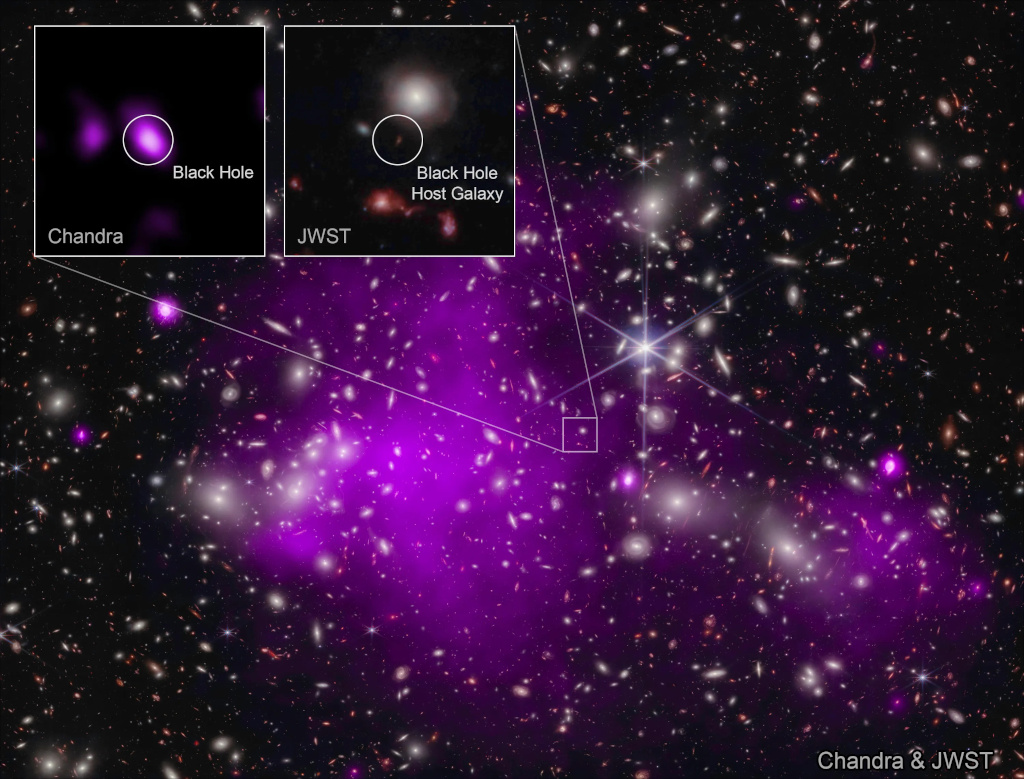
Dominated by dark matter, massive cluster of galaxies Abell 2744 is known to some as Pandora's Cluster. It lies 3.5 billion light-years away toward the constellation Sculptor. Using the galaxy cluster's enormous mass as a gravitational lens to warp spacetime and magnify even more distant objects directly behind it, astronomers have found a background galaxy, UHZ1, at a remarkable redshift of Z=10.1. That puts UHZ1 far beyond Abell 2744, at a distance of 13.2 billion light-years, seen when our universe was about 3 percent of its current age. UHZ1 is identified in the insets of this composited image combining X-rays (purple hues) from the spacebased Chandra X-ray Observatory and infrared light from the James Webb Space Telescope. The X-ray emission from UHZ1 detected in the Chandra data is the telltale signature of a growing supermassive black hole at the center of the ultra high redshift galaxy. That makes UHZ1's growing black hole the most distant black hole ever detected in X-rays, a result that now hints at how and when the first supermassive black holes in the universe formed.