Supernova Remnant
The structure resulting from the explosion of a star in a supernova. It consists of ejected material expanding from the explosion and the shocked interstellar medium it sweeps up.
Source
APODs including "Supernova Remnant"
NGC 6992: A Glimpse of the Veil
28 September 2001
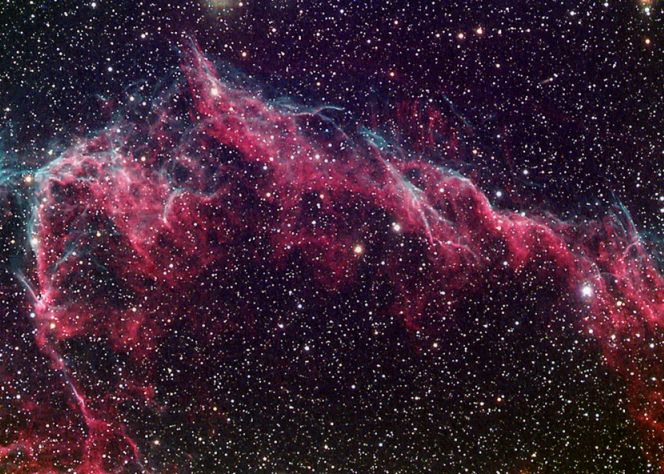
After 5,000 years, the gorgeous Veil Nebula is still turning heads. Cataloged as NGC 6992, these glowing filaments of interstellar shocked gas are part of a larger spherical supernova remnant known as the Cygnus Loop or the Veil Nebula -- expanding debris from a star which exploded over 5,000 years ago. This color digital image of a bit of the Veil has been processed and enhanced to reveal stunning details in the diaphanous cosmic cloud. Seen from our perspective against a rich Milky Way star field, the Veil Nebula is now known to lie some 1,400 light-years away toward the constellation Cygnus. At that distance, witnesses to the original stellar explosion would have seen a star in the heavens increase in brightness to about -8 magnitude, roughly corresponding to the brightness of the crescent Moon.