Supernova
A supernova is the explosive death of a star, during which it rapidly ejects most of its mass in a brilliant burst of light. In core‑collapse supernovae (Types Ib, Ic, II), massive stars (≥ 8 solar masses) exhaust their nuclear fuel, collapse under gravity, and explode. In Type Ia supernovae, a white dwarf in a binary system undergoes runaway fusion after accreting mass. These events deliver heavy elements into space, leave behind neutron stars or black holes, and power typical shock‑front supernova remnants.
Source: heasarc.gsfc.nasa.gov
APODs including "Supernova"
Supernova 1987a Aftermath
21/06/1995
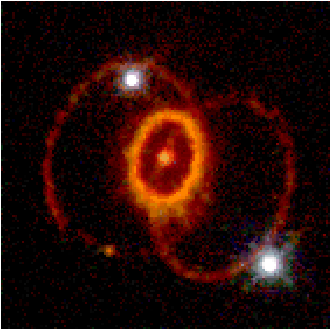
Today's Picture: June 21, 1995 The Aftermath of the Great Supernova in 1987 Picture Credit: Hubble Space Telescope Explanation: In 1987 a star in one of the Milky Way's satellite galaxies exploded. In 1994 the Hubble Space Telescope, in orbit around the earth, took a very detailed picture of the remnants of this explosion. This picture, above, showed unusual and unexpected rings, and astronomers are not sure how they formed. For more information see HST press release. We keep an archive of previous Astronomy Pictures of the Day. Astronomy Picture of the Day is brought to you by Robert Nemiroff and Jerry Bonnell . Original material on this page is copyrighted to Robert J. Nemiroff and Jerry T. Bonnell.