Supernova
A supernova is the explosive death of a star, during which it rapidly ejects most of its mass in a brilliant burst of light. In core‑collapse supernovae (Types Ib, Ic, II), massive stars (≥ 8 solar masses) exhaust their nuclear fuel, collapse under gravity, and explode. In Type Ia supernovae, a white dwarf in a binary system undergoes runaway fusion after accreting mass. These events deliver heavy elements into space, leave behind neutron stars or black holes, and power typical shock‑front supernova remnants.
Source: heasarc.gsfc.nasa.gov
APODs including "Supernova"
M1: The Exploding Crab Nebula
22/11/1995
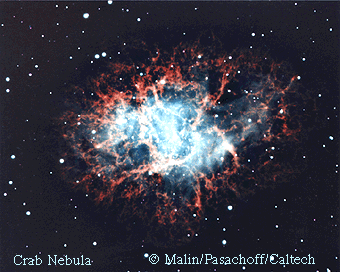
The Crab Nebula resulted from a star that exploded - a supernova. The outer layers of the star were thrown violently into space, while the inner core collapsed to form a neutron star. This neutron star is visible to us today as a pulsar - a rotating star at the center of the nebula that emits visible flashes of light. The Crab Pulsar flashes about 30 times every second. Although the stellar explosion that caused the Crab Nebula was seen over 900 years ago, the nebula itself still expands and shines. How the nebula obtains the energy needed to shine was a mystery eventually solved by noting that this energy could be released by the slowing of the pulsar's rotation.