Supernova
A supernova is the explosive death of a star, during which it rapidly ejects most of its mass in a brilliant burst of light. In core‑collapse supernovae (Types Ib, Ic, II), massive stars (≥ 8 solar masses) exhaust their nuclear fuel, collapse under gravity, and explode. In Type Ia supernovae, a white dwarf in a binary system undergoes runaway fusion after accreting mass. These events deliver heavy elements into space, leave behind neutron stars or black holes, and power typical shock‑front supernova remnants.
Source: heasarc.gsfc.nasa.gov
APODs including "Supernova"
Releasing Compton
29/11/1995
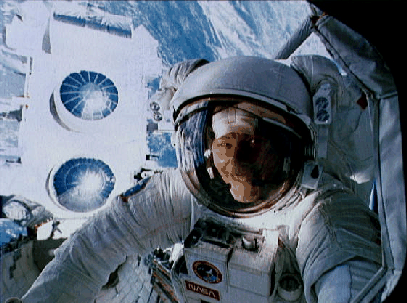
Named for Nobel laureate physicist Arthur Holly Compton, the Compton Gamma Ray Observatory (CGRO) Satellite was launched in April of 1991 aboard the Space Shuttle Atlantis. CGRO's mission is to explore the Universe at gamma-ray energies. The massive space based observatory is seen here held upright in the shuttle payload bay behind smiling astronaut Jerry Ross. Ross and his colleague Jay Apt have just finished a successful, unplanned spacewalk to free a jammed antenna prior to releasing CGRO into orbit. CGRO has been operating successfully since, providing the first all-sky survey at gamma-ray energies along with exciting new observations of the sun, quasars, pulsars, supernova, black holes, and gamma-ray bursts.