Supernova
A supernova is the explosive death of a star, during which it rapidly ejects most of its mass in a brilliant burst of light. In core‑collapse supernovae (Types Ib, Ic, II), massive stars (≥ 8 solar masses) exhaust their nuclear fuel, collapse under gravity, and explode. In Type Ia supernovae, a white dwarf in a binary system undergoes runaway fusion after accreting mass. These events deliver heavy elements into space, leave behind neutron stars or black holes, and power typical shock‑front supernova remnants.
Source: heasarc.gsfc.nasa.gov
APODs including "Supernova"
An X-ray Hot Supernova in M81
03/12/1995
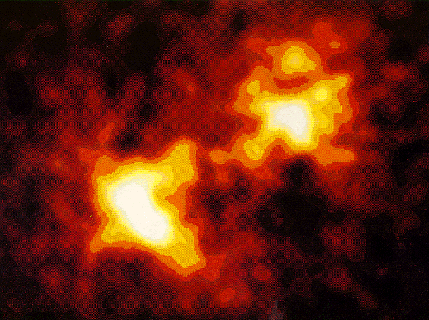
In 1993, a star in the galaxy M81 exploded. Above is a picture of the hot material ejected by this supernova explosion. The picture was taken in X-rays with the Advanced Satellite for Cosmology and Astrophysics (ASCA). Since M81 is a relatively nearby galaxy, it can be examined in close detail by observatories on or near the Earth. Since the Earth's atmosphere protects the surface from interstellar X-radiation, the above photo was taken from space. Studying the nature and distribution of the X-rays has allowed astronomers to determine the composition and temperature of the expanding supernova gas.