Supernova
A supernova is the explosive death of a star, during which it rapidly ejects most of its mass in a brilliant burst of light. In core‑collapse supernovae (Types Ib, Ic, II), massive stars (≥ 8 solar masses) exhaust their nuclear fuel, collapse under gravity, and explode. In Type Ia supernovae, a white dwarf in a binary system undergoes runaway fusion after accreting mass. These events deliver heavy elements into space, leave behind neutron stars or black holes, and power typical shock‑front supernova remnants.
Source: heasarc.gsfc.nasa.gov
APODs including "Supernova"
ASCA X-Ray Observatory
20/02/1996
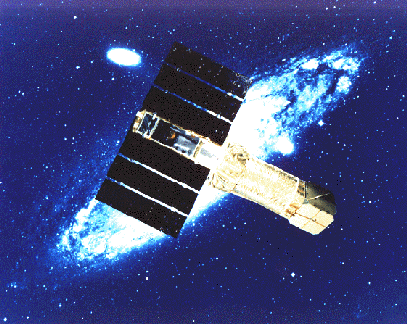
Today marks the third anniversary of the launch of the Advanced Satellite for Cosmology and Astrophysics (ASCA; renamed from Astro D when launched). ASCA, seen here superposed on galaxy M31, is a Japanese satellite for which NASA has provided some scientific equipment. ASCA carries four large-area X-ray telescopes. At the focus of two of the telescopes is a Gas Imaging Spectrometer (GIS), while a Solid-state Imaging Spectrometer (SIS) is at the focus of the other two. ASCA has provided recent evidence that high energy cosmic rays are formed in the expanding gas from a supernova. During ASCA's three years of operation, it has also yielded valuable data on quasars, supernova remnants, dwarf novae, pulsars, clusters of galaxies, and the mysterious X-ray background radiation that appears to come from all directions.