Supernova
A supernova is the explosive death of a star, during which it rapidly ejects most of its mass in a brilliant burst of light. In core‑collapse supernovae (Types Ib, Ic, II), massive stars (≥ 8 solar masses) exhaust their nuclear fuel, collapse under gravity, and explode. In Type Ia supernovae, a white dwarf in a binary system undergoes runaway fusion after accreting mass. These events deliver heavy elements into space, leave behind neutron stars or black holes, and power typical shock‑front supernova remnants.
Source: heasarc.gsfc.nasa.gov
APODs including "Supernova"
A Supernova in the Whirlpool
21/04/1996
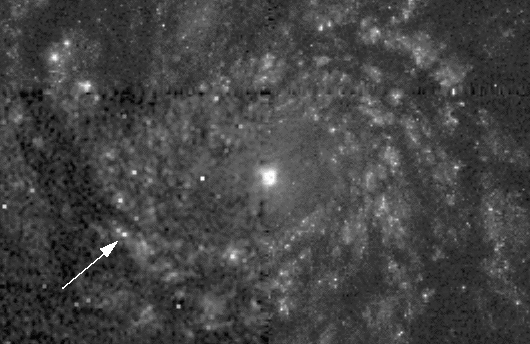
In 1994, a new star in a distant galaxy was seen by amateur astronomers, who alerted the world to their discovery of a supernova. Near the nucleus of spiral galaxy M51, popularly known as the Whirlpool, this supernova (1994I) is identified as the bright spot indicated by the arrow in the lower left of this Hubble Space Telescope image. Supernovae are violent death explosions of stars that eject radioactive debri clouds. They are often discovered by amateur observers dedicated to systematic searches of the sky and are of intense interest to astronomers who hope to learn what kind of stars generate these explosions and what chemical elements are produced and mixed into space. Distances to these these intrinsically bright events can also be determined, providing crucial yardsticks for measuring the Scale of the Universe.