Supernova
A supernova is the explosive death of a star, during which it rapidly ejects most of its mass in a brilliant burst of light. In core‑collapse supernovae (Types Ib, Ic, II), massive stars (≥ 8 solar masses) exhaust their nuclear fuel, collapse under gravity, and explode. In Type Ia supernovae, a white dwarf in a binary system undergoes runaway fusion after accreting mass. These events deliver heavy elements into space, leave behind neutron stars or black holes, and power typical shock‑front supernova remnants.
Source: heasarc.gsfc.nasa.gov
APODs including "Supernova"
Supernova Remnant: Cooking Elements In The LMC
09/05/1996
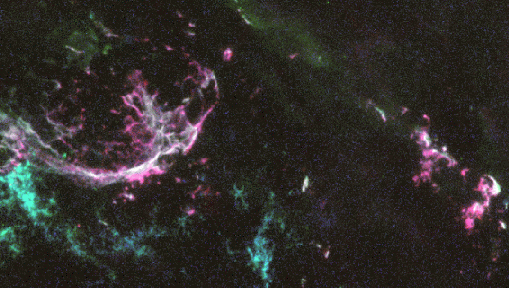
Massive stars cook elements in their cores through nuclear fusion. Starting with the light elements of hydrogen and helium, their central temperatures and pressures produce progressively heavier elements, carbon, oxygen, nitrogen, etc. up through iron. At the end of their lives they explode in a spectacular supernova, scattering these elements into space, contributing material to the formation of other stars and star systems. In fact, the elements making up life on Earth were baked in such a stellar oven! This Hubble Space Telescope image of a supernova remnant known as N132D in the Large Magellanic Cloud (LMC) allows astronomers to explore the details of this nuclear processing and mixing. It reveals luminous clouds of cooked supernova debris energized by shocks -- singly ionized sulfur appears red, doubly ionized oxygen, green, and singly ionized oxygen, blue. The region shown above is about 50 lightyears across.