Supernova
A supernova is the explosive death of a star, during which it rapidly ejects most of its mass in a brilliant burst of light. In core‑collapse supernovae (Types Ib, Ic, II), massive stars (≥ 8 solar masses) exhaust their nuclear fuel, collapse under gravity, and explode. In Type Ia supernovae, a white dwarf in a binary system undergoes runaway fusion after accreting mass. These events deliver heavy elements into space, leave behind neutron stars or black holes, and power typical shock‑front supernova remnants.
Source: heasarc.gsfc.nasa.gov
APODs including "Supernova"
Henize 70: A SuperBubble In The LMC
10/05/1996
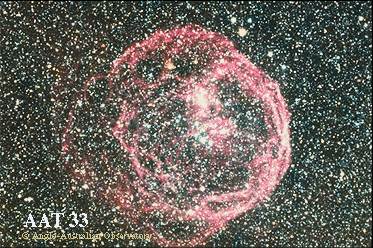
Massive stars (tens of times the mass of the Sun) profoundly affect their galactic environment. Churning and mixing the clouds of gas and dust between the stars, they leave their mark in the compositions and locations of future generations of stars and star systems. Dramatic evidence of this is beautifully illustrated in our neighboring galaxy, the Large Magellanic Cloud (LMC), by the lovely ring shaped nebula, Henize 70 (also known as N70 and DEM301). It is actually a luminous "superbubble" of interstellar gas about 300 lightyears in diameter, blown by winds from hot, massive stars and supernova explosions, its interior filled with tenuous hot expanding gas. These superbubbles offer astronomers a chance to explore this crucial connection between the lifecycles of stars and the evolution of galaxies.