Supernova
A supernova is the explosive death of a star, during which it rapidly ejects most of its mass in a brilliant burst of light. In core‑collapse supernovae (Types Ib, Ic, II), massive stars (≥ 8 solar masses) exhaust their nuclear fuel, collapse under gravity, and explode. In Type Ia supernovae, a white dwarf in a binary system undergoes runaway fusion after accreting mass. These events deliver heavy elements into space, leave behind neutron stars or black holes, and power typical shock‑front supernova remnants.
Source: heasarc.gsfc.nasa.gov
APODs including "Supernova"
Tycho's Supernova Remnant in X-ray
23/06/1996
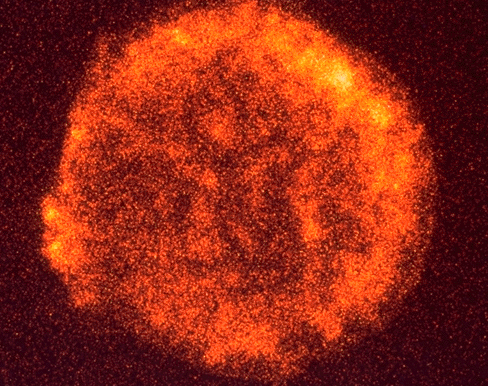
How often do stars explode? By looking at external galaxies, astronomers can guess that these events, known as a supernovae, should occur about once every 30 years in a typical spiral galaxy like our MilkyWay. However, the obscuring gas and dust in the disk of our galaxy probably prevents us from seeing many galactic supernovae -- making observations of these events in our own galaxy relatively rare. In fact, in 1572, the revered Danish astronomer, Tycho Brahe, witnessed one of the last to be seen. The remnant of this explosion is still visible today as the shockwave it generated continues to expand into the gas and dust between the stars. Above is an image of the X-rays emitted by this shockwave made by a telescope onboard the ROSAT spacecraft. The nebula is known as Tycho's Supernova Remnant.