Supernova
A supernova is the explosive death of a star, during which it rapidly ejects most of its mass in a brilliant burst of light. In core‑collapse supernovae (Types Ib, Ic, II), massive stars (≥ 8 solar masses) exhaust their nuclear fuel, collapse under gravity, and explode. In Type Ia supernovae, a white dwarf in a binary system undergoes runaway fusion after accreting mass. These events deliver heavy elements into space, leave behind neutron stars or black holes, and power typical shock‑front supernova remnants.
Source: heasarc.gsfc.nasa.gov
APODs including "Supernova"
A Star Forming Region in the LMC
25/06/1996
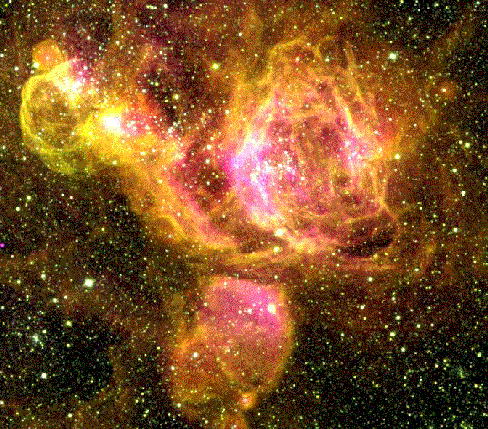
Stars sometimes form in colorful ways. Pictured above is a small region in the nearby LMC galaxy where stars are forming. After a star is born, it may do several things to energize its immediate neighborhood. It may develop a strong wind which pushes away nearby gas; it may be so hot and intense that emitted light boils away nearby dust and gas, and it may be so massive that it soon goes supernova and catapults its elements back to the interstellar medium. Astronomers study regions like this - named DEM192 - to better understand how these and other processes proceed. This picture is a composite of three separate photographs, each sensitive to only one specific color of light - a color that distinguishes a specific chemical element.