Supernova
A supernova is the explosive death of a star, during which it rapidly ejects most of its mass in a brilliant burst of light. In core‑collapse supernovae (Types Ib, Ic, II), massive stars (≥ 8 solar masses) exhaust their nuclear fuel, collapse under gravity, and explode. In Type Ia supernovae, a white dwarf in a binary system undergoes runaway fusion after accreting mass. These events deliver heavy elements into space, leave behind neutron stars or black holes, and power typical shock‑front supernova remnants.
Source: heasarc.gsfc.nasa.gov
APODs including "Supernova"
Star Wars in NGC 664 Credit:
25/02/1997
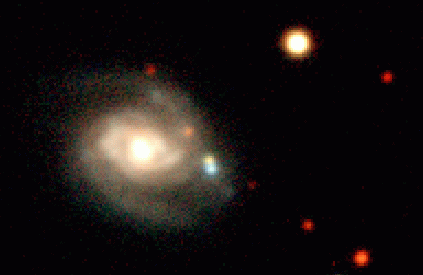
Long ago in a galaxy far, far away, locked in their final desperate struggle against the force of gravity ... two stars exploded! Stellar explosions - Supernovae - are among the most powerful events in the Universe, estimated to release an equivalent energy of up to 1 million trillion trillion (1 followed by 30 zeros) megatons of TNT. After the explosion, an expanding supernova envelope is observed to brighten over a a period of days to a maximum light output which rivals that of an entire galaxy before fading from view over the following months. Triggered by the collapsing core of a massive star or the nuclear demise of a white dwarf supernovae occur in average spiral galaxies only about once every 25-100 years. But a recent observation of NGC 664, a spiral galaxy about 300 million light years distant, captured a rare and colorful performance - two supernovae from the same galaxy. In this monitoring exposure the two supernovae, one reddish yellow and one blue, form a close pair just below the image center (to the right of the galaxy nucleus). The color difference is due to temperature - blue is hotter.