Supernova
A supernova is the explosive death of a star, during which it rapidly ejects most of its mass in a brilliant burst of light. In core‑collapse supernovae (Types Ib, Ic, II), massive stars (≥ 8 solar masses) exhaust their nuclear fuel, collapse under gravity, and explode. In Type Ia supernovae, a white dwarf in a binary system undergoes runaway fusion after accreting mass. These events deliver heavy elements into space, leave behind neutron stars or black holes, and power typical shock‑front supernova remnants.
Source: heasarc.gsfc.nasa.gov
APODs including "Supernova"
Spiral Galaxy M83 Credit and Copyright:
19/04/1997
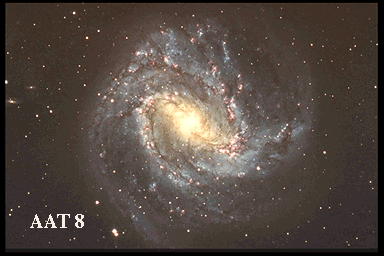
The long winding arms of this nearby spiral galaxy define it as the "Southern Pinwheel." But M83 is quite a typical spiral - much like our own Milky Way Galaxy. Spiral galaxies contains many billions of stars, the youngest of which inhabit the spiral arms and glow strongly in blue light. Dark dust lanes are mixed in with the stars and help define M83's marked spiral structure. The space between the spiral arms is also filled with stars - but stars that are typically more dim and red. M83 has shown an unusual amount of stellar supernovae explosions - six since the turn of the century - more than any other Messier galaxy.