Supernova
A supernova is the explosive death of a star, during which it rapidly ejects most of its mass in a brilliant burst of light. In core‑collapse supernovae (Types Ib, Ic, II), massive stars (≥ 8 solar masses) exhaust their nuclear fuel, collapse under gravity, and explode. In Type Ia supernovae, a white dwarf in a binary system undergoes runaway fusion after accreting mass. These events deliver heavy elements into space, leave behind neutron stars or black holes, and power typical shock‑front supernova remnants.
Source: heasarc.gsfc.nasa.gov
APODs including "Supernova"
The Frothy Milky Way Credit:
24/04/1997
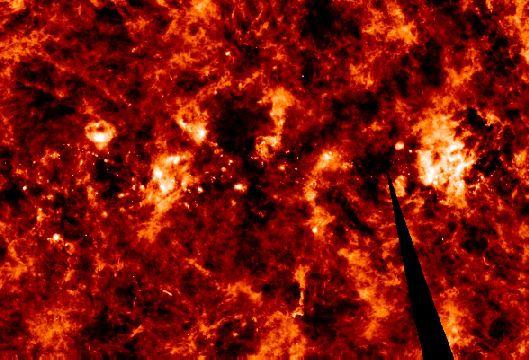
Astronomers have recently discovered that looking at dust along the plane of our Milky Way Galaxy is a bit like looking into a frothy glass of beer. The dust between stars in our galaxy is arranged like a foam with bubbles and voids -- apparently churned by shocks and winds generated as stars cycle through their lives. This processed infrared image, based on data from NASA's IRAS satellite, maps the radiation from the edges of galactic dust clouds and reveals the complex distribution. The image covers an area of about 40x60 degrees centered on the galactic plane near the Cygnus region. It shows bright bubble-shaped and arc-like dust clouds around the supernova remnants and starbirth regions embedded in the galactic disk.