Supernova
A supernova is the explosive death of a star, during which it rapidly ejects most of its mass in a brilliant burst of light. In core‑collapse supernovae (Types Ib, Ic, II), massive stars (≥ 8 solar masses) exhaust their nuclear fuel, collapse under gravity, and explode. In Type Ia supernovae, a white dwarf in a binary system undergoes runaway fusion after accreting mass. These events deliver heavy elements into space, leave behind neutron stars or black holes, and power typical shock‑front supernova remnants.
Source: heasarc.gsfc.nasa.gov
APODs including "Supernova"
NGC 1818: Pick A Star
15/04/1998
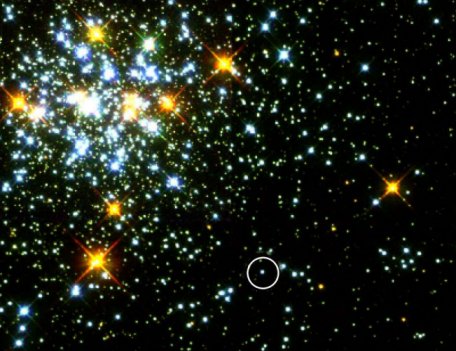
This is NGC 1818, a youthful, glittering cluster of 20,000 stars residing in the Large Magellanic Cloud, 164,000 light-years away. Pick a star. Any star. Astronomers might pick the unassuming bluish-white one (circled) which appears to be a hot newly formed white dwarf star. What makes it so interesting? The standard astronomical wisdom suggests that stars over 5 times as massive as the sun rapidly exhaust their nuclear fuel and end their lives in a spectacular supernova explosion. With less than this critical mass they evolve into red giants, pass through a relatively peaceful planetary nebula phase, and calmly fade away as white dwarf stars like this one. Except that as a member of the NGC 1818 cluster, this new white dwarf would have evolved from a red giant star over 7.6 times as massive as the sun - which should have exploded! Its discovery will likely force astronomers to revise the limiting mass estimate for supernovae upward.