Supernova
A supernova is the explosive death of a star, during which it rapidly ejects most of its mass in a brilliant burst of light. In core‑collapse supernovae (Types Ib, Ic, II), massive stars (≥ 8 solar masses) exhaust their nuclear fuel, collapse under gravity, and explode. In Type Ia supernovae, a white dwarf in a binary system undergoes runaway fusion after accreting mass. These events deliver heavy elements into space, leave behind neutron stars or black holes, and power typical shock‑front supernova remnants.
Source: heasarc.gsfc.nasa.gov
APODs including "Supernova"
GRB 980703: A Reassuring Redshift
13/07/1998
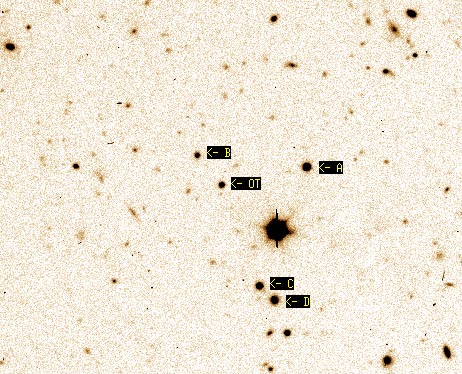
In the old days, just over a year ago, astronomers had little idea of the true distance to gamma-ray bursts. Did these enigmatic explosions occur in our outer Galaxy, or in the outer Universe? Last May, a first telling distance measure was made - GRB 970508 showed an absorption line with a redshift of about 0.8 - indicating that this gamma-ray burst (GRB) was an enormous distance away. Skeptics, however, are not always convinced by an unrepeated measurement. Since then, though, other tantalizing coincidences have occurred: GRB 971214 occurred unusually near a galaxy with the enormous redshift of 3.4, and GRB 980425 occurred unusually near a peculiar low-redshift supernova. Skeptics were intrigued. Now, the potentially definitive implications of the above-pictured optical transient might impress even the cautious. GRB 980703's optical transient shows a well-measured redshift from both an absorption line and an emission line: 0.97. The above negative highlights the uncommon transient source with the label "OT", while letters designate common comparison stars.