Supernova
A supernova is the explosive death of a star, during which it rapidly ejects most of its mass in a brilliant burst of light. In core‑collapse supernovae (Types Ib, Ic, II), massive stars (≥ 8 solar masses) exhaust their nuclear fuel, collapse under gravity, and explode. In Type Ia supernovae, a white dwarf in a binary system undergoes runaway fusion after accreting mass. These events deliver heavy elements into space, leave behind neutron stars or black holes, and power typical shock‑front supernova remnants.
Source: heasarc.gsfc.nasa.gov
APODs including "Supernova"
The Galactic Center - A Radio Mystery
28/01/1999
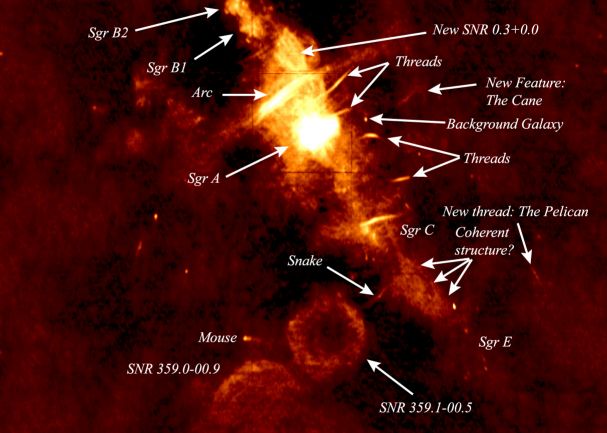
Tuning in to the center of our Milky Way galaxy, radio astronomers explore a complex, mysterious place. A premier high resolution view, this startlingly beautiful picture covers a 4x4 degree region around the galactic center. It was constructed from 1 meter wavelength radio data obtained by telescopes of the Very Large Array near Socorro, New Mexico, USA. The galactic center itself is at the edge of the extremely bright object labeled Sagittarius (Sgr) A, suspected of harboring a million solar mass black hole. Along the galactic plane which runs diagonally through the image are tortured clouds of gas energized by hot stars and round-shaped supernova remnants (SNRs) - hallmarks of a violent and energetic cosmic environment. But perhaps most intriguing are the arcs, threads, and filaments which abound in the scene. Their uncertain origins challenge present theories of the dynamics of the galactic center.