Supernova
A supernova is the explosive death of a star, during which it rapidly ejects most of its mass in a brilliant burst of light. In core‑collapse supernovae (Types Ib, Ic, II), massive stars (≥ 8 solar masses) exhaust their nuclear fuel, collapse under gravity, and explode. In Type Ia supernovae, a white dwarf in a binary system undergoes runaway fusion after accreting mass. These events deliver heavy elements into space, leave behind neutron stars or black holes, and power typical shock‑front supernova remnants.
Source: heasarc.gsfc.nasa.gov
APODs including "Supernova"
WR 104: Pinwheel Star
09/04/1999
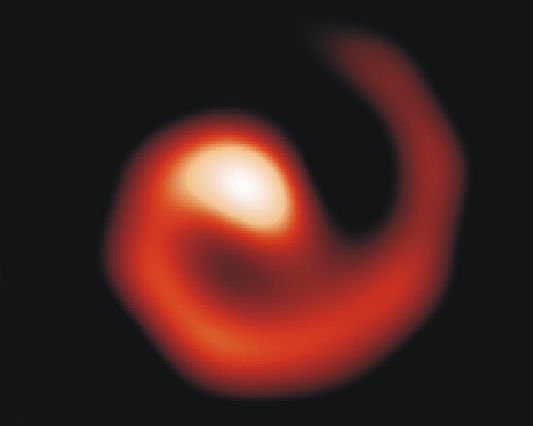
Like a cosmic lawn sprinkler, dust streaming from a rotating star system creates a pinwheel pattern in this false color infrared image. Astronomers discovered the surprising star dust scenario using a sophisticated interferometer and the 10 meter Keck I telescope to observe the bright Wolf-Rayet star WR 104. Wolf-Rayet stars are thought to be massive objects on the brink of a cataclysmic supernova explosion - having grown so hot and bright that their intense light begins to drive material away in a stellar wind. The problem is, their starlight would also be so intense that any dust flakes should be destroyed! A possible solution to this dusty dilemma is that a companion star exists hidden in the bright central region, generating wind interactions which shield a relatively narrow dust forming region from the light of WR 104. As the binary system rotates, the spray of surviving dust particles appears to spiral outward.