Supernova
A supernova is the explosive death of a star, during which it rapidly ejects most of its mass in a brilliant burst of light. In core‑collapse supernovae (Types Ib, Ic, II), massive stars (≥ 8 solar masses) exhaust their nuclear fuel, collapse under gravity, and explode. In Type Ia supernovae, a white dwarf in a binary system undergoes runaway fusion after accreting mass. These events deliver heavy elements into space, leave behind neutron stars or black holes, and power typical shock‑front supernova remnants.
Source: heasarc.gsfc.nasa.gov
APODs including "Supernova"
Candidates for a Hypernova
20/04/1999
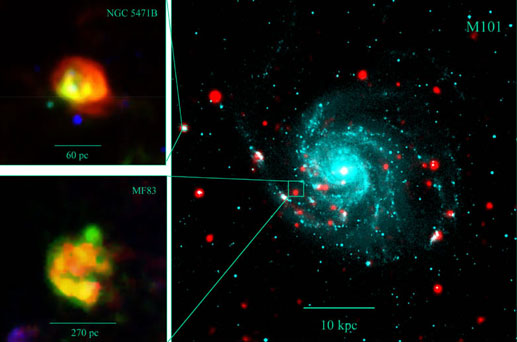
What created these huge explosion remnants? Speculation has been building recently that outbursts even more powerful than well-known supernovae might occur. Dubbed hypernovae, these explosions might result from high-mass stars and liberate perhaps ten times more energy than conventional supernovae. A hypernova was originally postulated to explain the great amount of energy seemingly liberated in a gamma-ray burst. A search for visible remnants of hypernovae has now yielded the above two candidates. Nearby spiral galaxy M101, shown on the right, has two large expanding shells that might have originated from a hypernova. Remnant NGC 5471B on the upper left and MF83 below were identified by the unusually high amount of X-ray radiation they emit. MF83 is also one of the largest expanding shells ever found. Research continues into the possible nature and visibility of hypernovae and the gas shells they likely leave behind.