Supernova
A supernova is the explosive death of a star, during which it rapidly ejects most of its mass in a brilliant burst of light. In core‑collapse supernovae (Types Ib, Ic, II), massive stars (≥ 8 solar masses) exhaust their nuclear fuel, collapse under gravity, and explode. In Type Ia supernovae, a white dwarf in a binary system undergoes runaway fusion after accreting mass. These events deliver heavy elements into space, leave behind neutron stars or black holes, and power typical shock‑front supernova remnants.
Source: heasarc.gsfc.nasa.gov
APODs including "Supernova"
The Local Bubble and the Galactic Neighborhood
12/04/2000
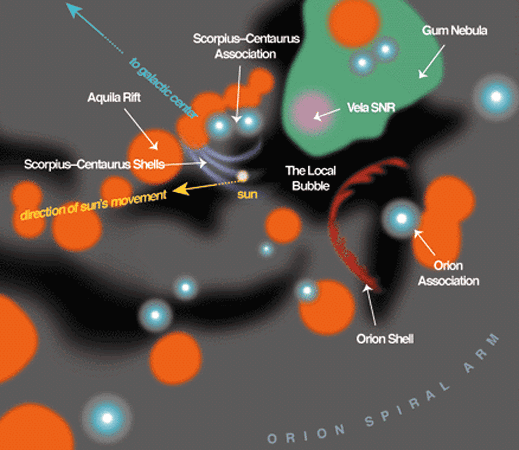
What surrounds the Sun in this neck of the Milky Way Galaxy? Our current best guess is depicted in the above map of the surrounding 1500 light years constructed from various observations and deductions. Currently, the Sun is passing through a Local Interstellar Cloud (LIC), shown in violet, which is flowing away from the Scorpius-Centaurus Association of young stars. The LIC resides in a low-density hole in the interstellar medium (ISM) called the Local Bubble, shown in black. Nearby, high-density molecular clouds including the Aquila Rift surround star forming regions, each shown in orange. The Gum Nebula, shown in green, is a region of hot ionized hydrogen gas. Inside the Gum Nebula is the Vela Supernova Remnant, shown in pink, which is expanding to create fragmented shells of material like the LIC. Future observations should help astronomers discern more about the local Galactic Neighborhood and how it might have affected Earth's past climate.