Supernova
A supernova is the explosive death of a star, during which it rapidly ejects most of its mass in a brilliant burst of light. In core‑collapse supernovae (Types Ib, Ic, II), massive stars (≥ 8 solar masses) exhaust their nuclear fuel, collapse under gravity, and explode. In Type Ia supernovae, a white dwarf in a binary system undergoes runaway fusion after accreting mass. These events deliver heavy elements into space, leave behind neutron stars or black holes, and power typical shock‑front supernova remnants.
Source: heasarc.gsfc.nasa.gov
APODs including "Supernova"
Supernova Remnant E0102-72 from Radio to X-Ray
14/04/2000
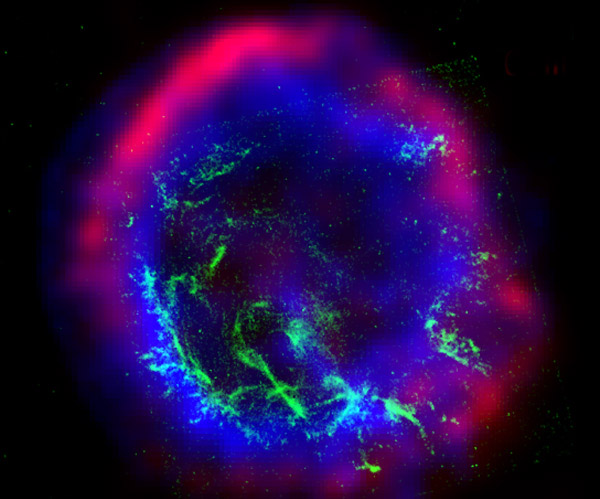
Not all stars form a big Q after they explode. The shape of supernova remnant E0102-72, however, is giving astronomers a clue about how tremendous explosions disperse elements and interact with surrounded gas. The above image is a composite of three different photographs in three different types of light. Radio waves, shown in red, trace high-energy electrons spiraling around magnetic field lines in the shock wave expanding out from the detonated star. Optical light, shown in green, traces clumps of relatively cool gas that includes oxygen. X-rays, shown in blue, show relatively hot gas that has been heated to millions of degrees. This gas has been heated by an inward moving shock wave that has rebounded from a collision with existing or slower moving gas. This big Q currently measures 40 light-years across and was found in our neighboring SMC galaxy. Perhaps we would know even more if we could buy a vowel.