Supernova
A supernova is the explosive death of a star, during which it rapidly ejects most of its mass in a brilliant burst of light. In core‑collapse supernovae (Types Ib, Ic, II), massive stars (≥ 8 solar masses) exhaust their nuclear fuel, collapse under gravity, and explode. In Type Ia supernovae, a white dwarf in a binary system undergoes runaway fusion after accreting mass. These events deliver heavy elements into space, leave behind neutron stars or black holes, and power typical shock‑front supernova remnants.
Source: heasarc.gsfc.nasa.gov
APODs including "Supernova"
At the Edge of the Crescent Nebula
02/08/2000
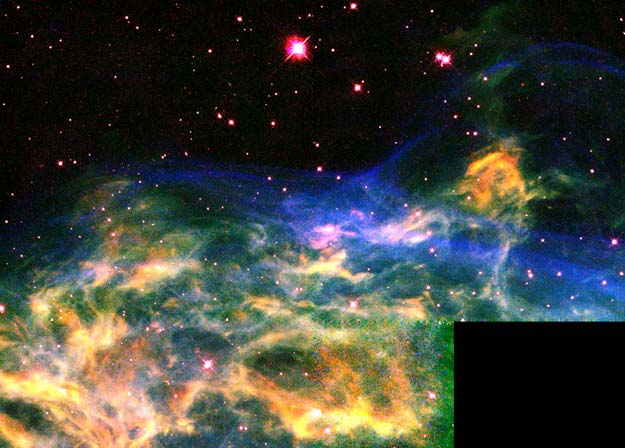
The Crescent Nebula is a rapidly expanding shell of gas surrounding a dying star. In this recently released image by the Hubble Space Telescope, a bright dynamic part of the nebula three light-years across is shown in representative color. The Crescent Nebula began to form about 250,000 years ago as central Wolf-Rayet star WR 136 began to shed its outer envelope in a strong stellar wind, expelling the equivalent of our Sun's mass every 10,000 years. This wind has been impacting surrounding interstellar gas, compacting it into a series of complex shells, and lighting it up. The Crescent Nebula, also known as NGC 6888, lies about 4,700 light-years away in the constellation of Cygnus and can only be seen through a telescope. Star WR 136 will probably undergo a supernova explosion sometime in the next million years.