Supernova
A supernova is the explosive death of a star, during which it rapidly ejects most of its mass in a brilliant burst of light. In core‑collapse supernovae (Types Ib, Ic, II), massive stars (≥ 8 solar masses) exhaust their nuclear fuel, collapse under gravity, and explode. In Type Ia supernovae, a white dwarf in a binary system undergoes runaway fusion after accreting mass. These events deliver heavy elements into space, leave behind neutron stars or black holes, and power typical shock‑front supernova remnants.
Source: heasarc.gsfc.nasa.gov
APODs including "Supernova"
Distant Supernova, Dark Energy
04/04/2001
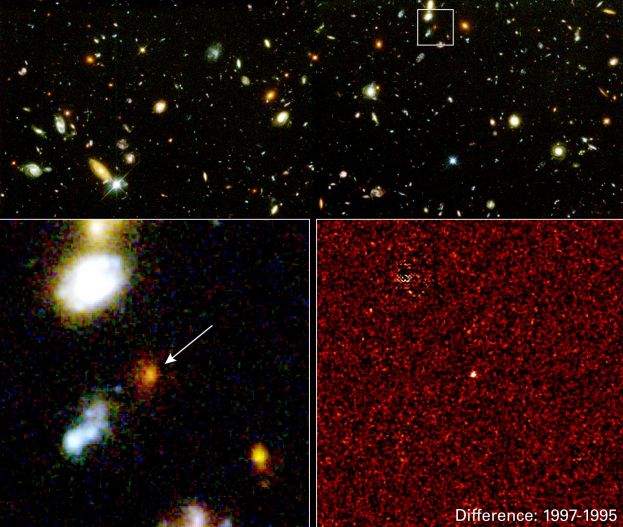
A pinpoint of light from a star that exploded over 10 billion light-years away is centered in the panel at the lower right, a cosmic snapshot of the most distant supernova. The ancient stellar detonation was detected by digitally subtracting before and after images of a faint, yellowish, elliptical galaxy included in the Hubble Space Telescope Deep Field image illustrated at the top and left. Remarkable in itself as the farthest known supernova, its measured brightness provides astounding evidence for a strange universe - one which eventually defies gravity and expands at an accelerating rate. The unseen force driving this expansion is attributed to "dark energy" and discovering the fundamental nature of dark energy has been called the challenge of this millennium.