Supernova
A supernova is the explosive death of a star, during which it rapidly ejects most of its mass in a brilliant burst of light. In core‑collapse supernovae (Types Ib, Ic, II), massive stars (≥ 8 solar masses) exhaust their nuclear fuel, collapse under gravity, and explode. In Type Ia supernovae, a white dwarf in a binary system undergoes runaway fusion after accreting mass. These events deliver heavy elements into space, leave behind neutron stars or black holes, and power typical shock‑front supernova remnants.
Source: heasarc.gsfc.nasa.gov
APODs including "Supernova"
Pulsar Wind in the Vela Nebula
19/07/2001
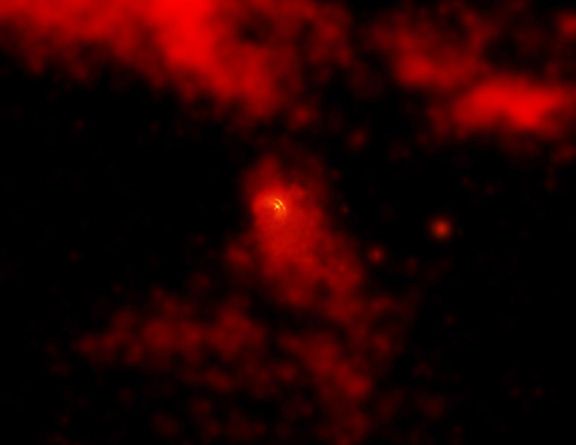
The Vela pulsar was born 10,000 years ago at the center of a supernova -- an exploding star. In this Chandra Observatory x-ray image, the pulsar still produces a glowing nebula at the heart of the expanding cloud of stellar debris. The pulsar itself is a neutron star, formed as the stellar core was compacted to nuclear densities. With a strong magnetic field, approximately the mass of the Sun, and a diameter of about 20 kilometers, the Vela pulsar rotates 11 times a second. The sharp Chandra image aids astronomers in understanding such extreme systems as efficient high-voltage generators which drive structured winds of electrically charged particles. An x-ray bright nebula is created as the pulsar winds slam into the surrounding material. This view spans about 6 light-years across the central region of the much larger Vela supernova remnant.