Supernova
A supernova is the explosive death of a star, during which it rapidly ejects most of its mass in a brilliant burst of light. In core‑collapse supernovae (Types Ib, Ic, II), massive stars (≥ 8 solar masses) exhaust their nuclear fuel, collapse under gravity, and explode. In Type Ia supernovae, a white dwarf in a binary system undergoes runaway fusion after accreting mass. These events deliver heavy elements into space, leave behind neutron stars or black holes, and power typical shock‑front supernova remnants.
Source: heasarc.gsfc.nasa.gov
APODs including "Supernova"
NGC 6992: A Glimpse of the Veil
28/09/2001
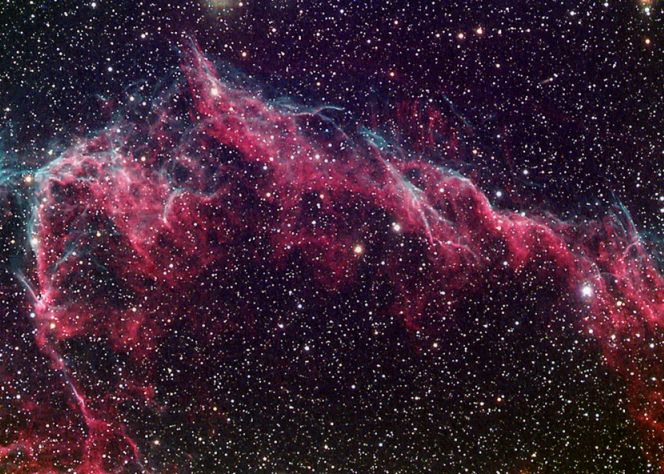
After 5,000 years, the gorgeous Veil Nebula is still turning heads. Cataloged as NGC 6992, these glowing filaments of interstellar shocked gas are part of a larger spherical supernova remnant known as the Cygnus Loop or the Veil Nebula -- expanding debris from a star which exploded over 5,000 years ago. This color digital image of a bit of the Veil has been processed and enhanced to reveal stunning details in the diaphanous cosmic cloud. Seen from our perspective against a rich Milky Way star field, the Veil Nebula is now known to lie some 1,400 light-years away toward the constellation Cygnus. At that distance, witnesses to the original stellar explosion would have seen a star in the heavens increase in brightness to about -8 magnitude, roughly corresponding to the brightness of the crescent Moon.