Supernova
A supernova is the explosive death of a star, during which it rapidly ejects most of its mass in a brilliant burst of light. In core‑collapse supernovae (Types Ib, Ic, II), massive stars (≥ 8 solar masses) exhaust their nuclear fuel, collapse under gravity, and explode. In Type Ia supernovae, a white dwarf in a binary system undergoes runaway fusion after accreting mass. These events deliver heavy elements into space, leave behind neutron stars or black holes, and power typical shock‑front supernova remnants.
Source: heasarc.gsfc.nasa.gov
APODs including "Supernova"
The Incredible Expanding Crab
27/12/2001
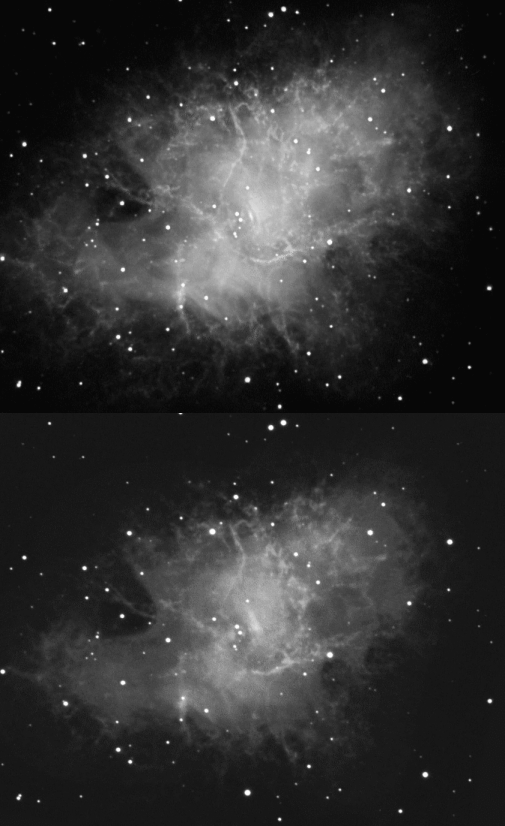
The Crab Nebula is cataloged as M1, the first on Charles Messier's famous list of things which are not comets. In fact, the Crab is now known to be a supernova remnant, an expanding cloud of debris from the explosion of a massive star. The violent birth of the Crab was witnessed by astronomers in the year 1054. Roughly 10 light-years across today, the nebula is still expanding at a rate of over 1,000 kilometers per second. Flipping between two images made nearly 30 years apart, this animation clearly demonstrates the expansion. The smaller Crab was recorded as a photographic image made in 1973 using the Kitt Peak National Observatory 4-meter telescope in 1973. The expanded Crab was made this year with the Kitt Peak Visitor Center's 0.4-meter telescope and digital camera. Background stars were used to register the two images.