Supernova
A supernova is a powerful and luminous explosion that occurs at the end of a star’s life, driven by either the core collapse of a massive star or a thermonuclear runaway in a white dwarf within a binary system.
In core-collapse supernovae, massive stars (> 8 M☉) exhaust their nuclear fuel, and their iron cores collapse under gravity. The resulting shock wave violently expels the outer layers. The remnant core becomes a neutron star or black hole. These explosions seed the interstellar medium with heavy elements synthesized during the collapse and explosion.
In Type Ia supernovae, a white dwarf in a binary system accumulates material until it approaches the Chandrasekhar limit (~1.4 M☉). A runaway fusion reaction ensues, completely disrupting the star. These events have a nearly uniform peak brightness, making them excellent standard candles for measuring cosmic distances and the expansion of the Universe.
Supernovae can outshine entire galaxies for weeks or months and drive shock waves that create complex remnants like the Cygnus Loop, observable across the electromagnetic spectrum.
They are rare events—occurring roughly once per century in a galaxy like the Milky Way—but are rich in diagnostic data. For example, Hubble’s study of a Type Ia supernova in NGC 2525 helped refine distance measurements and corrected for cosmic dust effects to improve our understanding of universal expansion.
Supernovae also produce neutrinos and cosmic rays, and their remnants compress gas leading to next-generation star formation. They play a central role in galactic evolution and element creation.
Some rare supernovae, such as SN 1979C and SN 1987A, continue emitting X-rays or show detailed ring structures decades later—providing invaluable insight into stellar death and circumstellar interaction.
Looking ahead, missions like ESA’s Euclid telescope and ground-based observatories (E-ELT, LSST) will observe thousands of supernovae, expanding our ability to map dark energy and the Universe’s expansion history.
Sources
- NASA – Type Ia Supernovae (Roman Telescope)
- ESA/Hubble – Supernova wordbank
- NASA – Supernovae Definition & Importance
- NASA Hubble – Supernova Distance Measurements
- NASA – Exploding Star Neutrino & Cosmic Ray Production
- ESA – SN 1979C Long-lived X-rays
- NASA Hubble – Supernova Blast Wave
- NASA – Supernova in NGC 2525
- ESA/DOE – Milky Way Supernova Rate & Nucleosynthesis
- ESA/ESA Future Facilities for Supernova Cosmology (arXiv)
APODs including "Supernova"
M51: X-Rays from the Whirlpool
11 July 2002
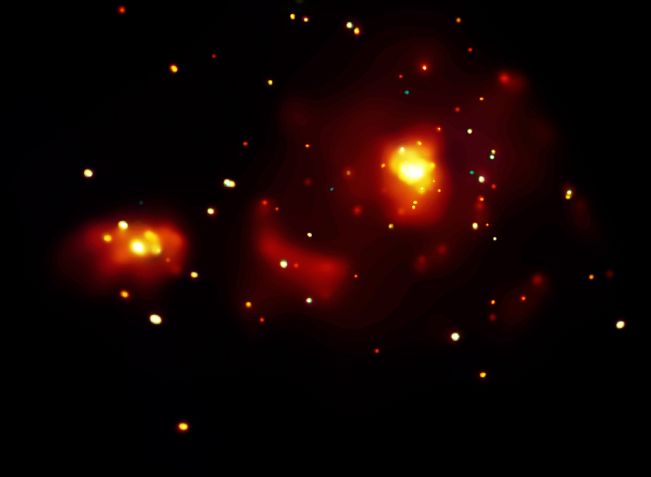
Fresh from yesterday's episode, a popular pair of interacting galaxies known as the Whirlpool debut here beyond the realm of visible light -- imaged at high energies by the orbiting Chandra X-ray Observatory. Still turning in a remarkable performance, over 80 glittering x-ray stars are present in the Chandra image data from the region. The number of luminous x-ray sources, likely neutron star and black hole binary systems within the confines of M51, is unusually high for normal spiral or elliptical galaxies and suggests this cosmic whirlpool has experienced intense bursts of massive star formation. The bright cores of both galaxies, NGC 5194 and NGC 5195 (right and left respectively), also exhibit high-energy activity in this false-color x-ray picture showing a diffuse glow from multi-million degree gas. An expanded view of the region near the core of NGC 5194 reveals x-rays from a supernova remnant, the debris from a spectacular stellar explosion, first detected by earthbound astronomers in 1994.