Supernova
A supernova is the explosive death of a star, during which it rapidly ejects most of its mass in a brilliant burst of light. In core‑collapse supernovae (Types Ib, Ic, II), massive stars (≥ 8 solar masses) exhaust their nuclear fuel, collapse under gravity, and explode. In Type Ia supernovae, a white dwarf in a binary system undergoes runaway fusion after accreting mass. These events deliver heavy elements into space, leave behind neutron stars or black holes, and power typical shock‑front supernova remnants.
Source: heasarc.gsfc.nasa.gov
APODs including "Supernova"
Recycling Cassiopeia A
12/07/2002
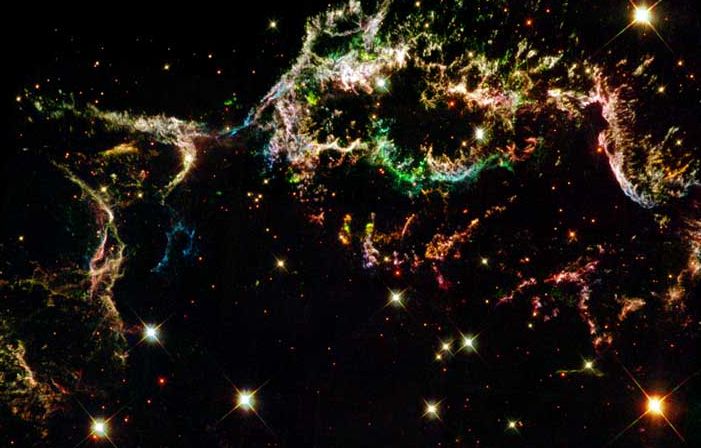
For billions of years, massive stars in our Milky Way Galaxy have lived spectacular lives. Collapsing from vast cosmic clouds, their nuclear furnaces ignite and create heavy elements in their cores. After a few million years, the enriched material is blasted back into interstellar space where star formation begins anew. The expanding debris cloud known as Cassiopeia A is an example of this final phase of the stellar life cycle. Light from the explosion which created this supernova remnant was probably first seen in planet Earth's sky just over 300 years ago, although it took that light more than 10,000 years to reach us. In this gorgeous Hubble Space Telescope image of cooling filaments and knots in the Cas A remnant, light from specific elements has been color coded to help astronomers understand the recycling of our galaxy's star stuff. For instance, red regions are dominated by emission from sulfur atoms while blue shades correspond to oxygen. The area shown is about 10 light-years across.