Supernova
A supernova is the explosive death of a star, during which it rapidly ejects most of its mass in a brilliant burst of light. In core‑collapse supernovae (Types Ib, Ic, II), massive stars (≥ 8 solar masses) exhaust their nuclear fuel, collapse under gravity, and explode. In Type Ia supernovae, a white dwarf in a binary system undergoes runaway fusion after accreting mass. These events deliver heavy elements into space, leave behind neutron stars or black holes, and power typical shock‑front supernova remnants.
Source: heasarc.gsfc.nasa.gov
APODs including "Supernova"
The Heart in NGC 346
14/02/2003
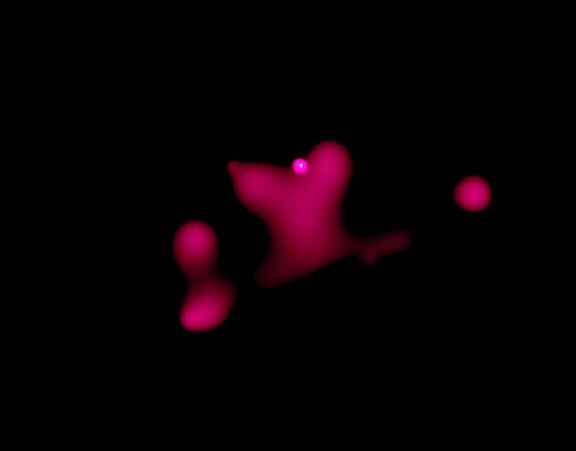
Yes, it's Valentine's Day (!) and looking toward star cluster NGC 346 in our neighboring galaxy the Small Magellanic Cloud, astronomers have noted this heart-shaped cloud of hot, x-ray emitting gas in the cluster's central region. The false-color Chandra Observatory x-ray image also shows a strong x-ray source just above the heart-shaped cloud which corresponds to HD 5980, a remarkable, massive binary star system that lies within the cluster. HD 5980 has been known to undergo dramatic brightness variations, in 1994 briefly outshining all other stars in the Small Magellanic Cloud, and has been likened to the luminous, eruptive variable star Eta Carinae in our own Milky Way galaxy. At about 100 light-years across, NGC 346's heart-shaped cloud is probably the result of an ancient supernova explosion. Alternatively it may have been produced during past eruptions from the HD 5980 system, analogous to the nebula associated with Eta Carinae.