Supernova
A supernova is the explosive death of a star, during which it rapidly ejects most of its mass in a brilliant burst of light. In core‑collapse supernovae (Types Ib, Ic, II), massive stars (≥ 8 solar masses) exhaust their nuclear fuel, collapse under gravity, and explode. In Type Ia supernovae, a white dwarf in a binary system undergoes runaway fusion after accreting mass. These events deliver heavy elements into space, leave behind neutron stars or black holes, and power typical shock‑front supernova remnants.
Source: heasarc.gsfc.nasa.gov
APODs including "Supernova"
A Slow Explosion
25/03/2003
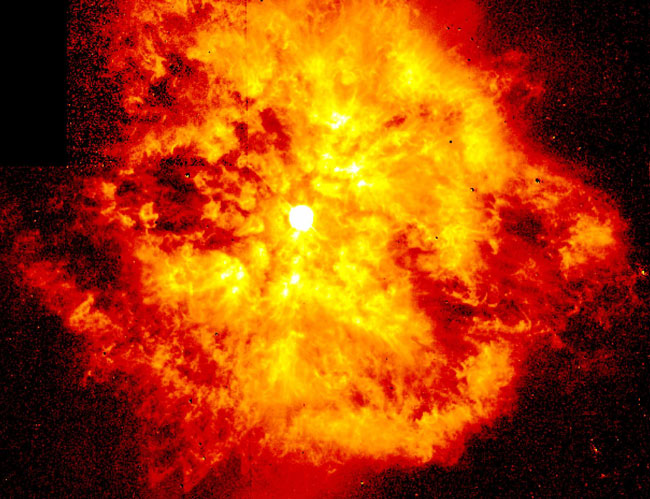
Why would a gamma ray burst fade so slowly? This behavior, recorded last October, is considered a new clue into the cause of gamma-ray bursts, the most powerful explosions known in the universe. The burst, first detected by the orbiting HETE satellite and later tracked by numerous ground-based telescopes, showed an unusually slow and tumultuous decay in visible light. Speculations on the cause of the unusual light curve include a blast wave striking a windy circumburst medium, a blast wave energetically refreshed by a faster outgoing shock, and non-uniformity in a fast moving jet. Pictured above is the massive Wolf-Rayet star WR124, a star itself undergoing a slow explosion by producing a very powerful but tumultuous wind. Popular candidate progenitor sources for GRBs include supernova or hypernova explosions from massive stars, possibly ones with similarities to Wolf-Rayet stars.