Supernova
A supernova is the explosive death of a star, during which it rapidly ejects most of its mass in a brilliant burst of light. In core‑collapse supernovae (Types Ib, Ic, II), massive stars (≥ 8 solar masses) exhaust their nuclear fuel, collapse under gravity, and explode. In Type Ia supernovae, a white dwarf in a binary system undergoes runaway fusion after accreting mass. These events deliver heavy elements into space, leave behind neutron stars or black holes, and power typical shock‑front supernova remnants.
Source: heasarc.gsfc.nasa.gov
APODs including "Supernova"
Spiral Galaxy NGC 3982 Before Supernova
03/11/2003
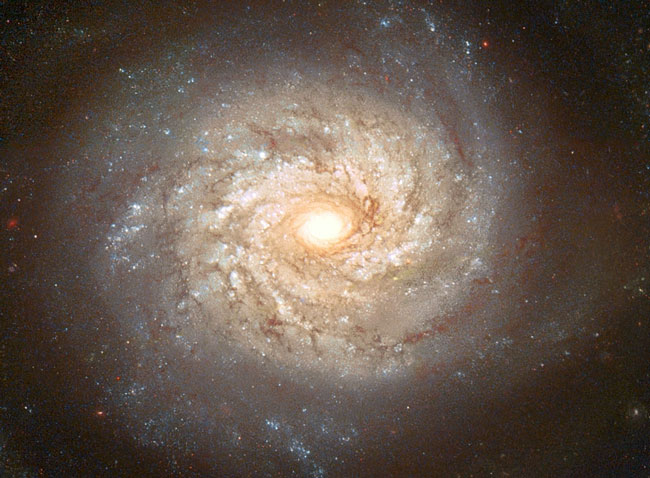
What do stars look like just before they explode? To find out, astronomers are taking detailed images of nearby galaxies now, before any supernova is visible. Hopefully, a star in one of the hundreds of high resolution galaxy images will explode in the coming years. If so, archival images like that taken above by the Hubble Space Telescope can be inspected to find what the star looked like originally. This information is likely important for better understanding of how and why supernovas occur, as well as why some supernovas appear brighter than others. Pictured above, beautiful spiral galaxy NGC 3982 displays numerous spiral arms filled with bright stars, blue star clusters, and dark dust lanes. NGC 3982, which spans about 30,000 light years, lies about 60 million light years from Earth and can be seen with a small telescope toward the constellation of Ursa Major.