Supernova
A supernova is the explosive death of a star, during which it rapidly ejects most of its mass in a brilliant burst of light. In core‑collapse supernovae (Types Ib, Ic, II), massive stars (≥ 8 solar masses) exhaust their nuclear fuel, collapse under gravity, and explode. In Type Ia supernovae, a white dwarf in a binary system undergoes runaway fusion after accreting mass. These events deliver heavy elements into space, leave behind neutron stars or black holes, and power typical shock‑front supernova remnants.
Source: heasarc.gsfc.nasa.gov
APODs including "Supernova"
NGC 1569: Starburst in a Small Galaxy
05/02/2004
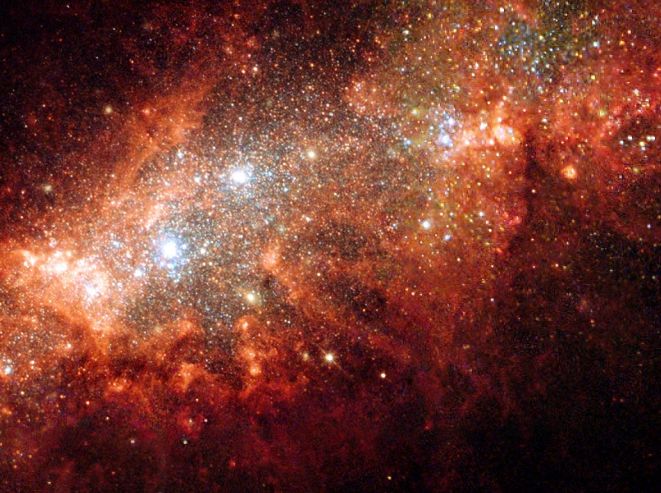
Grand spiral galaxies often seem to get all the glory, flaunting their young, bright, blue star clusters in beautiful, symmetric spiral arms. But small, irregular galaxies form stars too. In fact, as pictured here, dwarf galaxy NGC 1569 is apparently undergoing a burst of star forming activity, thought to have begun over 25 million years ago. The resulting turbulent environment is fed by supernova explosions as the cosmic detonations spew out material and trigger further star formation. Two massive star clusters - youthful counterparts to globular star clusters in our own spiral Milky Way galaxy - are seen left of center in the gorgeous Hubble Space Telescope image. The picture spans about 1,500 light-years across NGC 1569. A mere 7 million light-years distant, this relatively close starburst galaxy offers astronomers an excellent opportunity to study stellar populations in rapidly evolving galaxies. NGC 1569 lies in the long-necked constellation Camelopardalis.