Supernova
A supernova is the explosive death of a star, during which it rapidly ejects most of its mass in a brilliant burst of light. In core‑collapse supernovae (Types Ib, Ic, II), massive stars (≥ 8 solar masses) exhaust their nuclear fuel, collapse under gravity, and explode. In Type Ia supernovae, a white dwarf in a binary system undergoes runaway fusion after accreting mass. These events deliver heavy elements into space, leave behind neutron stars or black holes, and power typical shock‑front supernova remnants.
Source: heasarc.gsfc.nasa.gov
APODs including "Supernova"
Supernova Remnant Imaged in Gamma Rays
05/11/2004
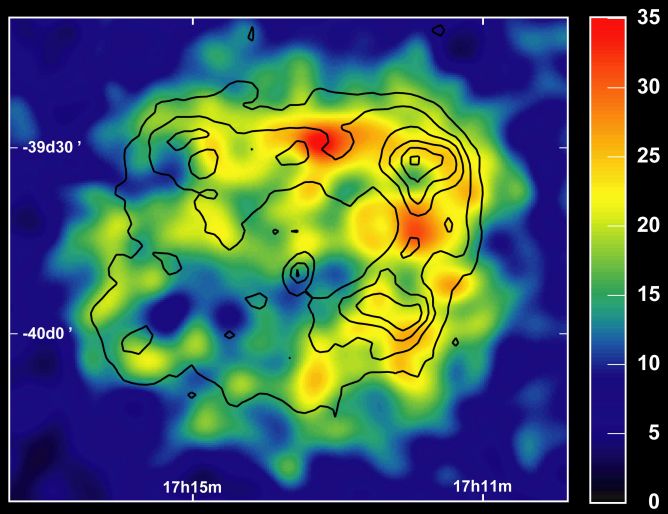
Gamma rays are the most energetic form of light. With up to a billion times the energy of ordinary "medical" x-rays, they easily penetrate telescope lenses and mirrors, making it very difficult to create gamma-ray images of cosmic sources. Still, an array of large telescopes designed to detect gamma-ray induced atmospheric flashes - the HESS (High Energy Stereoscopic System) experiment - has produced this historic, resolved image of a supernova remnant at extreme gamma-ray energies. Astronomers note that the premier gamma-ray view of the expanding stellar debris cloud is clearly similar to x-ray images of the remnant and convincingly supports the idea that these sites of powerful shock waves are also sources of cosmic rays within our galaxy. The gamma-ray intensity is color-coded in the picture, shown with dark contour lines that trace levels of x-ray emission from the object. At an estimated distance of 3,000 light-years, the supernova remnant measures about 50 light-years across and lies near the galactic plane.