Supernova
A supernova is the explosive death of a star, during which it rapidly ejects most of its mass in a brilliant burst of light. In core‑collapse supernovae (Types Ib, Ic, II), massive stars (≥ 8 solar masses) exhaust their nuclear fuel, collapse under gravity, and explode. In Type Ia supernovae, a white dwarf in a binary system undergoes runaway fusion after accreting mass. These events deliver heavy elements into space, leave behind neutron stars or black holes, and power typical shock‑front supernova remnants.
Source: heasarc.gsfc.nasa.gov
APODs including "Supernova"
What the Hubble Saw
25/11/2004
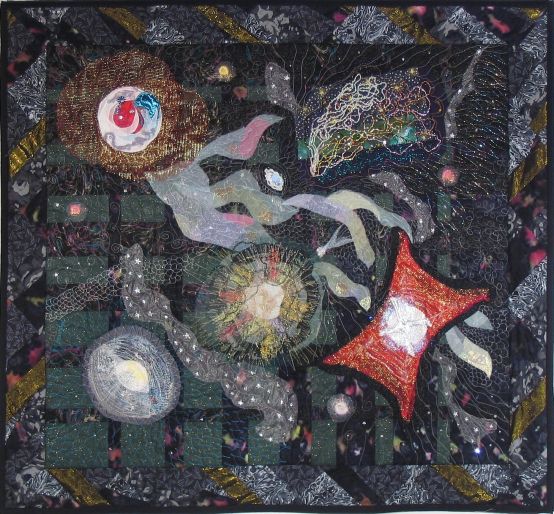
In this striking 41 inch by 38 inch quilt, astronomy enthusiast Judy Ross has interpreted some of the Hubble Space Telescope's best galactic and extragalactic vistas. Featured in past APODs, clockwise from the lower right are; the Red Rectangle Nebula, NGC 2392, the Sleeping Beauty Galaxy, V838 Monocerotis - the Milky Way's most mysterious star, and supernova remnant N49 - the cosmic debris from an exploded star. Of course, quilts have been used historically to represent astronomical concepts. And while inspired by the images of the cosmos that she incorporates into her quilts, Ross reports that she is still a little daunted by the intricacies of the Cat's Eye Nebula revealed by the Hubble's sharp vision.