Supernova
A supernova is the explosive death of a star, during which it rapidly ejects most of its mass in a brilliant burst of light. In core‑collapse supernovae (Types Ib, Ic, II), massive stars (≥ 8 solar masses) exhaust their nuclear fuel, collapse under gravity, and explode. In Type Ia supernovae, a white dwarf in a binary system undergoes runaway fusion after accreting mass. These events deliver heavy elements into space, leave behind neutron stars or black holes, and power typical shock‑front supernova remnants.
Source: heasarc.gsfc.nasa.gov
APODs including "Supernova"
The N44 Superbubble
06/02/2006
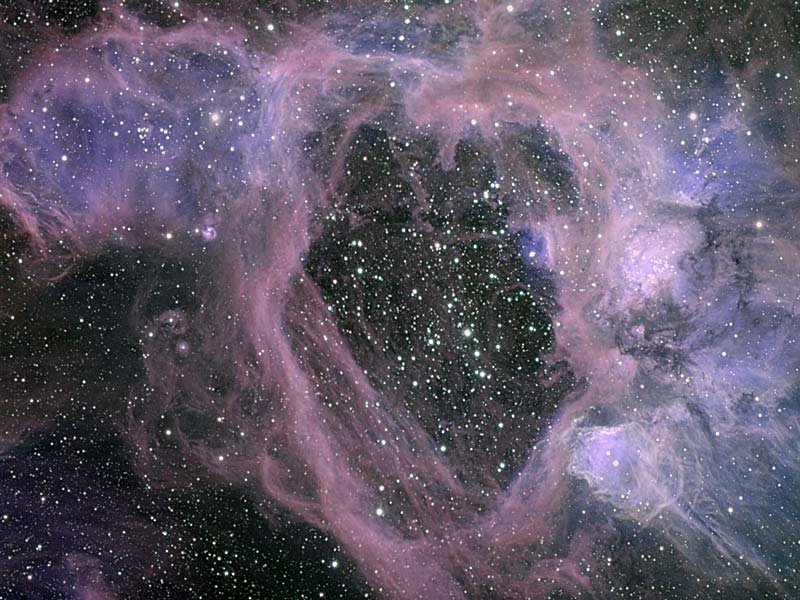
What created this gigantic hole? The vast emission nebula N44 in our neighboring galaxy the Large Magellanic Cloud has a large, 250 light-year hole and astronomers are trying to figure out why. One possibility is particle winds expelled by massive stars in the bubble's interior that are pushing out the glowing gas. This answer has been recently found to be inconsistent with measured wind velocities, however. Another possibility is that the expanding shells of old supernovas have sculpted the unusual space cavern. An unexpected clue of hot X-ray emitting gas was recently been detected escaping the N44 superbubble. The above image, here digitally sharpened, was taken in three very specific colors by the huge 8-meter Gemini South Telescope on Cerro Pachon in Chile.