Supernova
A supernova is the explosive death of a star, during which it rapidly ejects most of its mass in a brilliant burst of light. In core‑collapse supernovae (Types Ib, Ic, II), massive stars (≥ 8 solar masses) exhaust their nuclear fuel, collapse under gravity, and explode. In Type Ia supernovae, a white dwarf in a binary system undergoes runaway fusion after accreting mass. These events deliver heavy elements into space, leave behind neutron stars or black holes, and power typical shock‑front supernova remnants.
Source: heasarc.gsfc.nasa.gov
APODs including "Supernova"
Spiral Galaxy NGC 2403 from Subaru
05/07/2006
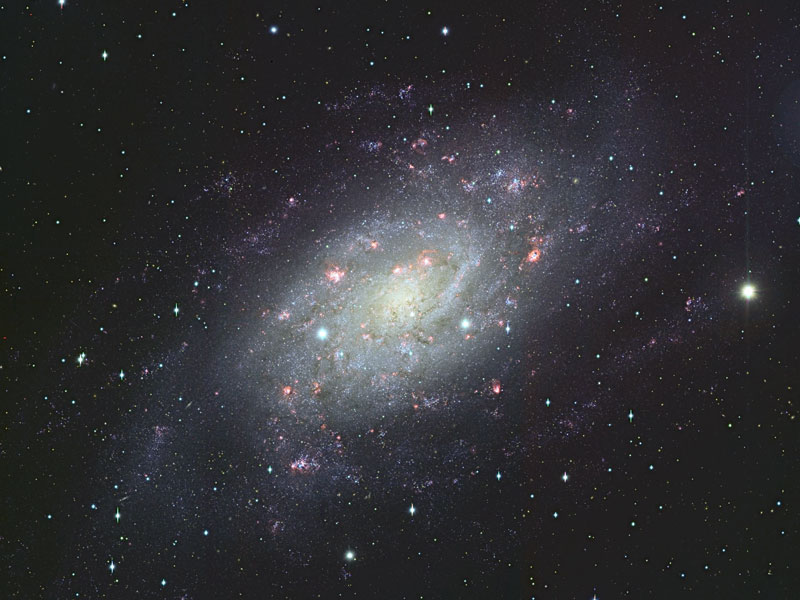
Sprawling spiral arms dotted with bright red emission nebulas highlight this new and detailed image of nearby spiral galaxy NGC 2403. Also visible in the photogenic spiral galaxy are blue open clusters, dark dust lanes, and a bright but relatively small central nucleus. NGC 2403 is located just beyond the Local Group of Galaxies, at a relatively close 10 million light years away toward the constellation of the Giraffe (Camelopardalis). NGC 2403 has a designated Hubble type of Sc. In 2004, NGC 2403 was home to one of the brightest supernovas of modern times. The above image, the highest resolution complete image of NGC 2403 ever completed, was taken by the Japan's 8.3-meter Subaru telescope located on Mauna Kea, Hawaii, USA.