Supernova
A supernova is the explosive death of a star, during which it rapidly ejects most of its mass in a brilliant burst of light. In core‑collapse supernovae (Types Ib, Ic, II), massive stars (≥ 8 solar masses) exhaust their nuclear fuel, collapse under gravity, and explode. In Type Ia supernovae, a white dwarf in a binary system undergoes runaway fusion after accreting mass. These events deliver heavy elements into space, leave behind neutron stars or black holes, and power typical shock‑front supernova remnants.
Source: heasarc.gsfc.nasa.gov
APODs including "Supernova"
Rumors of a Strange Universe
24/12/2006
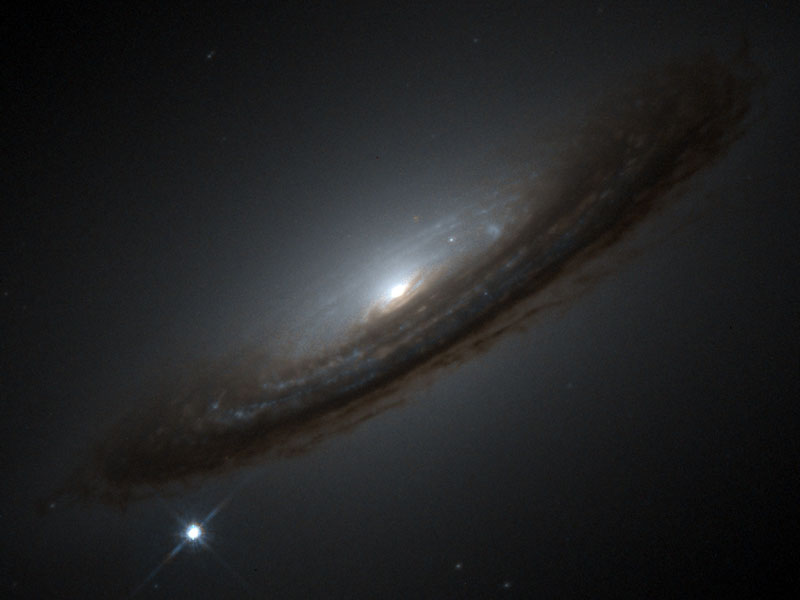
ght years ago results were first presented indicating that most of the energy in our universe is not in stars or galaxies but is tied to space itself. In the language of cosmologists, a large cosmological constant is directly implied by new distant supernovae observations. Suggestions of a cosmological constant (lambda) are not new -- they have existed since the advent of modern relativistic cosmology. Such claims were not usually popular with astronomers, though, because lambda is so unlike known universe components, because lambda's value appeared limited by other observations, and because less-strange cosmologies without lambda had previously done well in explaining the data. What is noteworthy here is the seemingly direct and reliable method of the observations and the good reputations of the scientists conducting the investigations. Over the past eight years, independent teams of astronomers have continued to accumulate data that appears to confirm the unsettling result. The above picture of a supernova that occurred in 1994 on the outskirts of a spiral galaxy was taken by one of these collaborations.