Supernova
A supernova is the explosive death of a star, during which it rapidly ejects most of its mass in a brilliant burst of light. In core‑collapse supernovae (Types Ib, Ic, II), massive stars (≥ 8 solar masses) exhaust their nuclear fuel, collapse under gravity, and explode. In Type Ia supernovae, a white dwarf in a binary system undergoes runaway fusion after accreting mass. These events deliver heavy elements into space, leave behind neutron stars or black holes, and power typical shock‑front supernova remnants.
Source: heasarc.gsfc.nasa.gov
APODs including "Supernova"
The N44 Complex
27/03/2008
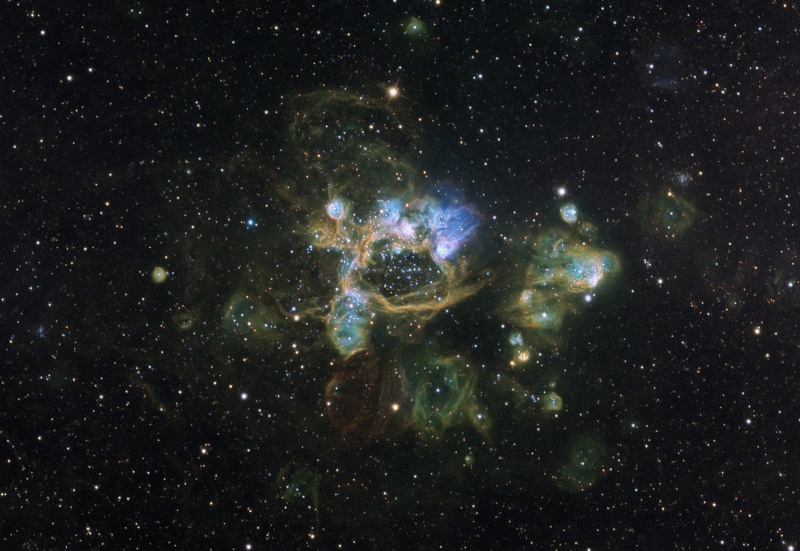
A truly giant complex of emission nebulae, N44 is about 1,000 light-years across. It shines in southern skies as a denizen of our neighboring galaxy, the Large Magellanic Cloud, 170,000 light-years away. Winds and intense radiation from hot, young, luminous stars in N44 excite and sculpt filaments and streamers of the glowing nebular gas. But supernovae - the death explosions of the massive short lived stars - have also likely contributed to the region's enormous, blown-out shapes. The cluster of young stars seen near the center lies in a superbubble nearly 250 light-years across. This detailed, false-color view of the intricate structures codes emission from hydrogen, oxygen, and sulfur in shades of blue and green.