Supernova
A supernova is the explosive death of a star, during which it rapidly ejects most of its mass in a brilliant burst of light. In core‑collapse supernovae (Types Ib, Ic, II), massive stars (≥ 8 solar masses) exhaust their nuclear fuel, collapse under gravity, and explode. In Type Ia supernovae, a white dwarf in a binary system undergoes runaway fusion after accreting mass. These events deliver heavy elements into space, leave behind neutron stars or black holes, and power typical shock‑front supernova remnants.
Source: heasarc.gsfc.nasa.gov
APODs including "Supernova"
Thor's Helmet (NGC 2359) and Planetary Nebula
12/03/2009
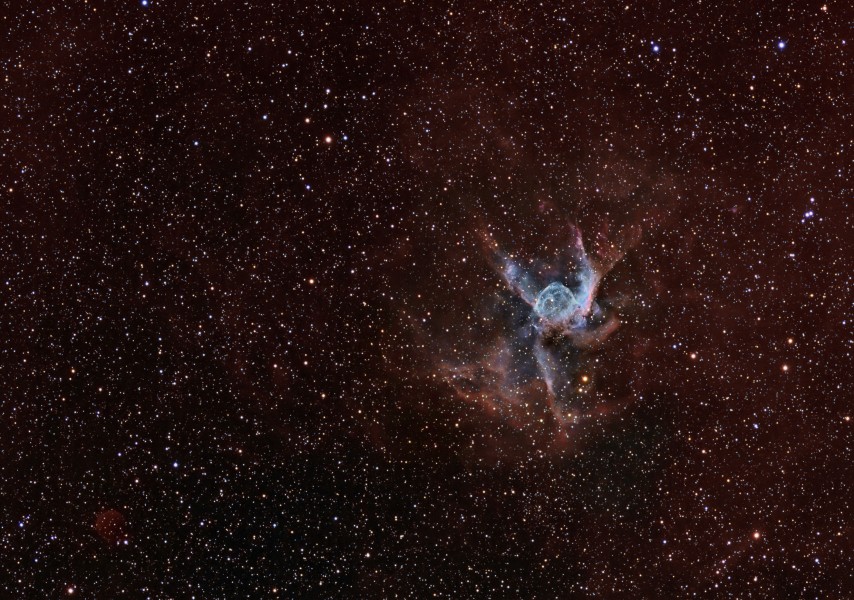
At the right, Thor's Helmet (NGC 2359) seems to gaze across a lovely star field. The broad skyscape itself covers about 1.5 degrees or 3 full moons toward the constellation Canis Major. A close look at the lower left corner of the image might identify the object of the cosmic stare as a faint, round nebula. Heroically sized even for a Norse god, Thor's Helmet is about 30 light-years across. The helmet is actually more like an interstellar bubble, blown as a fast wind from the bright, massive star near the bubble's center sweeps through a surrounding molecular cloud. Known as a Wolf-Rayet star, the central star is an extremely hot giant thought to be in a brief, pre- supernova stage of evolution. In contrast, the faint, round nebula is a planetary nebula, the gaseous shroud of a dying lower mass star. The distance to Thor's Helmet is estimated to be about 15,000 light-years.