Supernova
A supernova is the explosive death of a star, during which it rapidly ejects most of its mass in a brilliant burst of light. In core‑collapse supernovae (Types Ib, Ic, II), massive stars (≥ 8 solar masses) exhaust their nuclear fuel, collapse under gravity, and explode. In Type Ia supernovae, a white dwarf in a binary system undergoes runaway fusion after accreting mass. These events deliver heavy elements into space, leave behind neutron stars or black holes, and power typical shock‑front supernova remnants.
Source: heasarc.gsfc.nasa.gov
APODs including "Supernova"
Starry Night Scavenger Hunt
15/06/2010
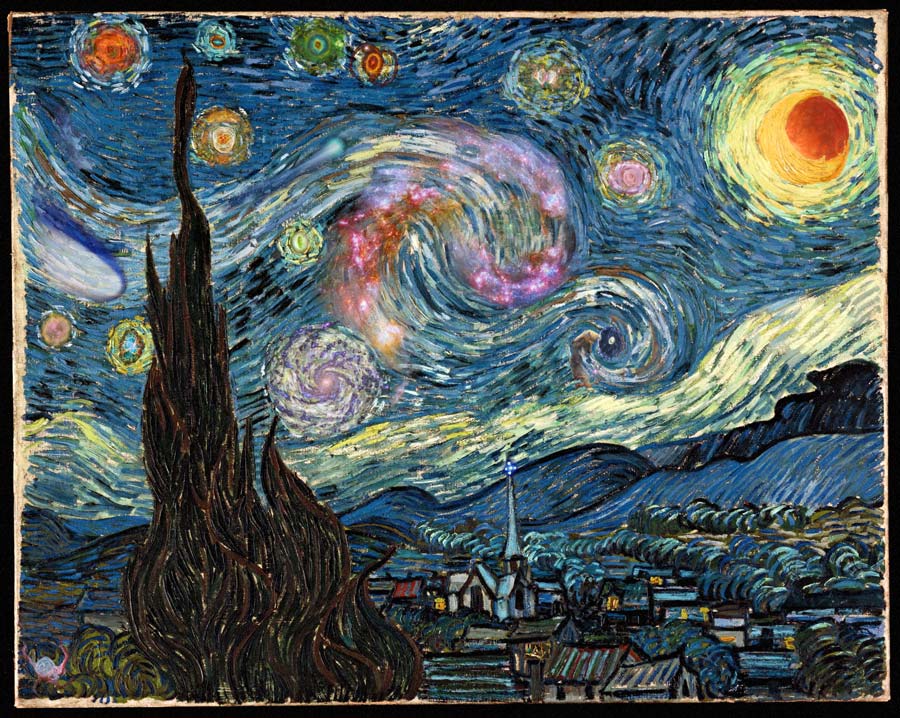
Did you know that Van Gogh's painting Starry Night includes Comet Hale-Bopp? Hopefully not, because it doesn't. But the above image does. Although today's featured picture may appear at first glance to be a faithful digital reproduction of the original Starry Night, actually it is a modern rendition meant not only to honor one of the most famous paintings of the second millennium, but to act as a scavenger hunt. Can you find, in the above image, a comet, a spiral galaxy, an open star cluster, and a supernova remnant? Too easy? OK, then find, the rings of Supernova 1987A, NGC 2392, the Crab Nebula, Thor's Helmet, the Cartwheel Galaxy, and the Ant Nebula. Still too easy? Then please identify any more hidden images not mentioned here -- and there are several -- on APOD's main discussion board: Starship Asterisk. Finally, the collagist has graciously hidden APOD's 10th anniversary Vermeer photomontage to help honor APOD on its 15th anniversary tomorrow.