Supernova
A supernova is the explosive death of a star, during which it rapidly ejects most of its mass in a brilliant burst of light. In core‑collapse supernovae (Types Ib, Ic, II), massive stars (≥ 8 solar masses) exhaust their nuclear fuel, collapse under gravity, and explode. In Type Ia supernovae, a white dwarf in a binary system undergoes runaway fusion after accreting mass. These events deliver heavy elements into space, leave behind neutron stars or black holes, and power typical shock‑front supernova remnants.
Source: heasarc.gsfc.nasa.gov
APODs including "Supernova"
Simeis 147: Supernova Remnant
12/02/2011
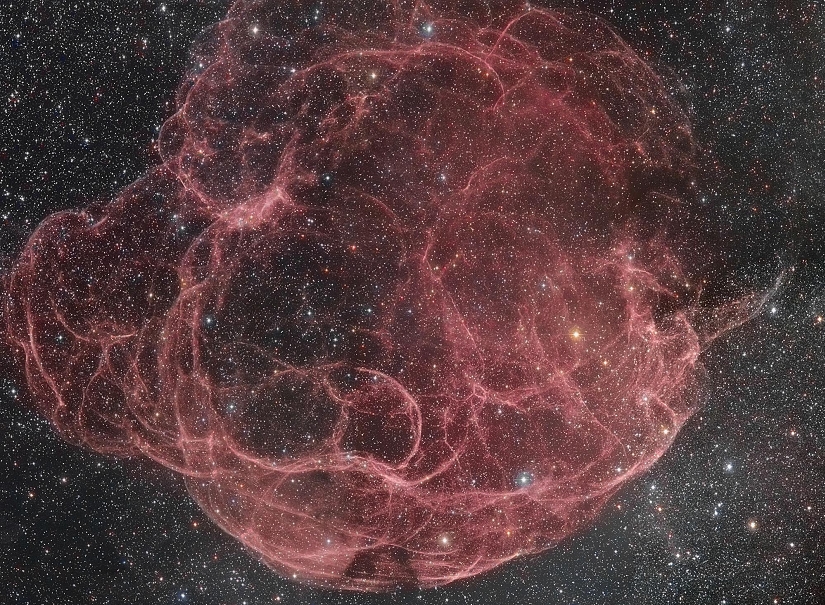
It's easy to get lost following the intricate filaments in this detailed mosaic image of faint supernova remnant Simeis 147. Also cataloged as Sh2-240 and seen towards the constellation Taurus, it covers nearly 3 degrees (6 full moons) on the sky. That corresponds to a width of 150 light-years at the stellar debris cloud's estimated distance of 3,000 light-years. The remarkable composite includes image data taken through narrow-band filters to highlight emission from hydrogen and oxygen atoms tracing regions of shocked, glowing gas. This supernova remnant has an estimated age of about 40,000 years - meaning light from the massive stellar explosion first reached Earth 40,000 years ago. But this expanding remnant is not the only aftermath. The cosmic catastrophe also left behind a spinning neutron star or pulsar, all that remains of the original star's core.