Supernova
A supernova is the explosive death of a star, during which it rapidly ejects most of its mass in a brilliant burst of light. In core‑collapse supernovae (Types Ib, Ic, II), massive stars (≥ 8 solar masses) exhaust their nuclear fuel, collapse under gravity, and explode. In Type Ia supernovae, a white dwarf in a binary system undergoes runaway fusion after accreting mass. These events deliver heavy elements into space, leave behind neutron stars or black holes, and power typical shock‑front supernova remnants.
Source: heasarc.gsfc.nasa.gov
APODs including "Supernova"
Ice Fishing for Cosmic Neutrinos
13/02/2011
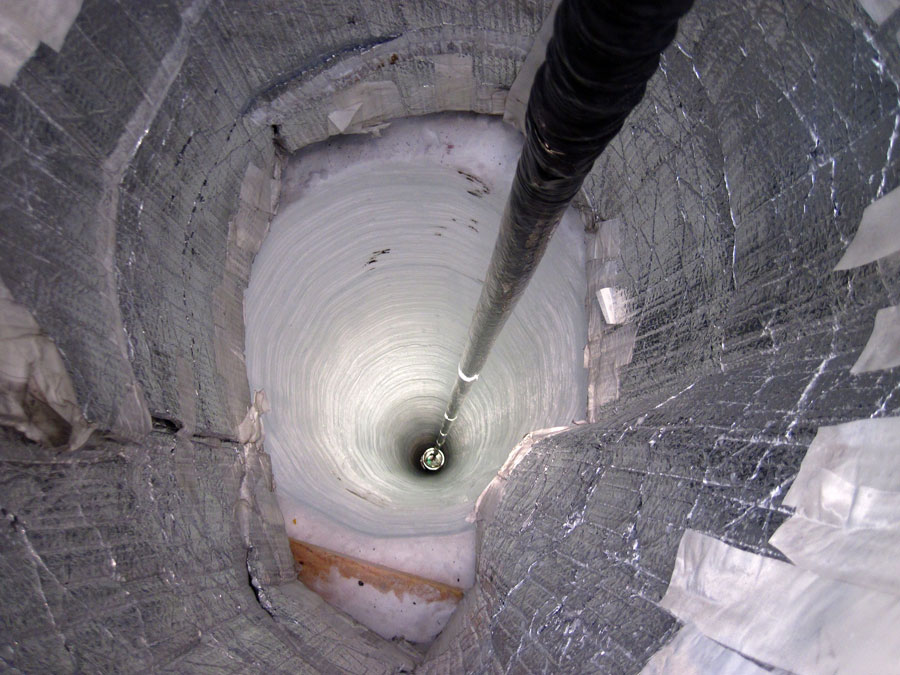
Scientists are melting holes in the bottom of the world. In fact, almost 100 holes melted near the South Pole are now being used as astronomical observatories. Astronomers with the IceCube Neutrino Observatory lowered into each vertical lake a long string knotted with basketball-sized light detectors. The water in each hole soon refreezes. The detectors attached to the strings are sensitive to blue light emitted in the surrounding clear ice. Such light is expected from ice collisions with high-energy neutrinos emitted by objects or explosions out in the universe. Late last year, the last of IceCube's 86 strings was lowered into the freezing abyss, pictured above, making IceCube the largest neutrino detector yet created. Data from a preliminary experiment, AMANDA, has already been used to create the first detailed map of the high-energy neutrino sky. Experimental goals of the newer IceCube include a search for cosmic sources of neutrinos, a search for neutrinos coincident with nearby supernova and distant gamma-ray bursts, and, if lucky, a probe of exotic physical concepts such as unseen spatial dimensions and faster-than-light travel.