Supernova
A supernova is the explosive death of a star, during which it rapidly ejects most of its mass in a brilliant burst of light. In core‑collapse supernovae (Types Ib, Ic, II), massive stars (≥ 8 solar masses) exhaust their nuclear fuel, collapse under gravity, and explode. In Type Ia supernovae, a white dwarf in a binary system undergoes runaway fusion after accreting mass. These events deliver heavy elements into space, leave behind neutron stars or black holes, and power typical shock‑front supernova remnants.
Source: heasarc.gsfc.nasa.gov
APODs including "Supernova"
NGC 5584: Expanding the Universe
30/03/2011
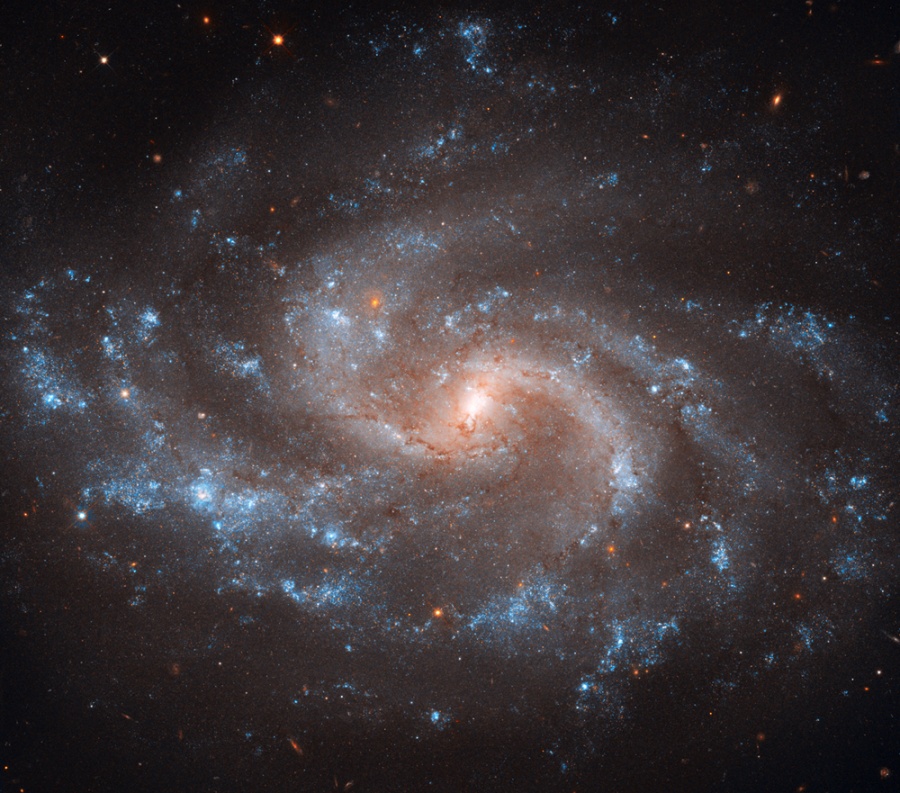
Big, beautiful NGC 5584 is more that 50,000 light-years across and lies 72 million light-years away toward the constellation Virgo. The winding spiral arms of this gorgeous island universe are loaded with luminous young star clusters and dark dust lanes. Still, for earthbound astronomers NGC 5584 is not just another pretty face-on spiral galaxy. Home to some 250 Cepheid variable stars and a recent Type Ia supernova explosion, key objects for astronomical distance determinations, NGC 5584 is one of 8 galaxies used in a new study that includes additional Hubble Space Telescope observations to improve the measurement of Hubble's Constant - the expansion rate of the Universe. The results of the study lend weight to the theory that dark energy really is responsible for accelerating the expansion of the Universe, restricting models that try to explain the observed acceleration without the mysterious dark energy. In this sharp Hubble image of NGC 5584, many of the small reddish smudges are distant background galaxies.