Supernova
A supernova is the explosive death of a star, during which it rapidly ejects most of its mass in a brilliant burst of light. In core‑collapse supernovae (Types Ib, Ic, II), massive stars (≥ 8 solar masses) exhaust their nuclear fuel, collapse under gravity, and explode. In Type Ia supernovae, a white dwarf in a binary system undergoes runaway fusion after accreting mass. These events deliver heavy elements into space, leave behind neutron stars or black holes, and power typical shock‑front supernova remnants.
Source: heasarc.gsfc.nasa.gov
APODs including "Supernova"
Light Echoes from V838 Mon
04/12/2011
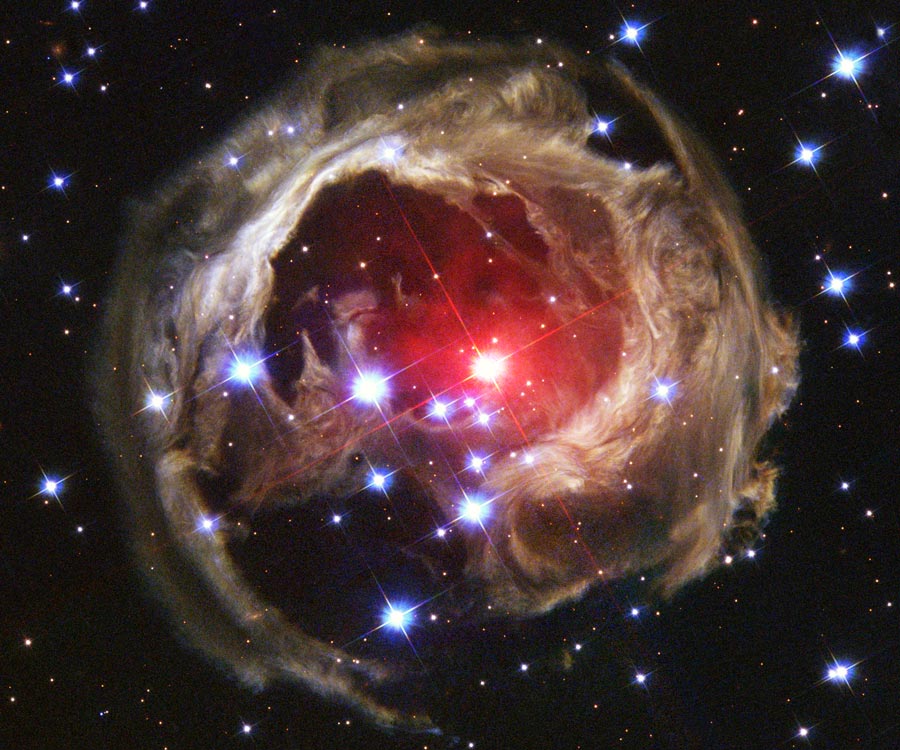
For reasons unknown, star V838 Mon's outer surface suddenly greatly expanded with the result that it became the brightest star in the entire Milky Way Galaxy in January 2002. Then, just as suddenly, it faded. A stellar flash like this had never been seen before. It's true that supernovae and novae expel matter out into space. But while the V838 Mon flash appears to expel material into space, what is seen here is actually an outwardly moving light echo of the bright flash. In a light echo, light from the flash is reflected by successively more distant rings in the ambient interstellar dust that already surrounded the star. V838 Mon lies about 20,000 light years away toward the constellation of Monoceros the unicorn. In this Hubble Space Telescope image from February 2004, the light echo is about six light years in diameter.