Supernova
A supernova is the explosive death of a star, during which it rapidly ejects most of its mass in a brilliant burst of light. In core‑collapse supernovae (Types Ib, Ic, II), massive stars (≥ 8 solar masses) exhaust their nuclear fuel, collapse under gravity, and explode. In Type Ia supernovae, a white dwarf in a binary system undergoes runaway fusion after accreting mass. These events deliver heavy elements into space, leave behind neutron stars or black holes, and power typical shock‑front supernova remnants.
Source: heasarc.gsfc.nasa.gov
APODs including "Supernova"
The Mysterious Rings of Supernova 1987A
26/02/2012
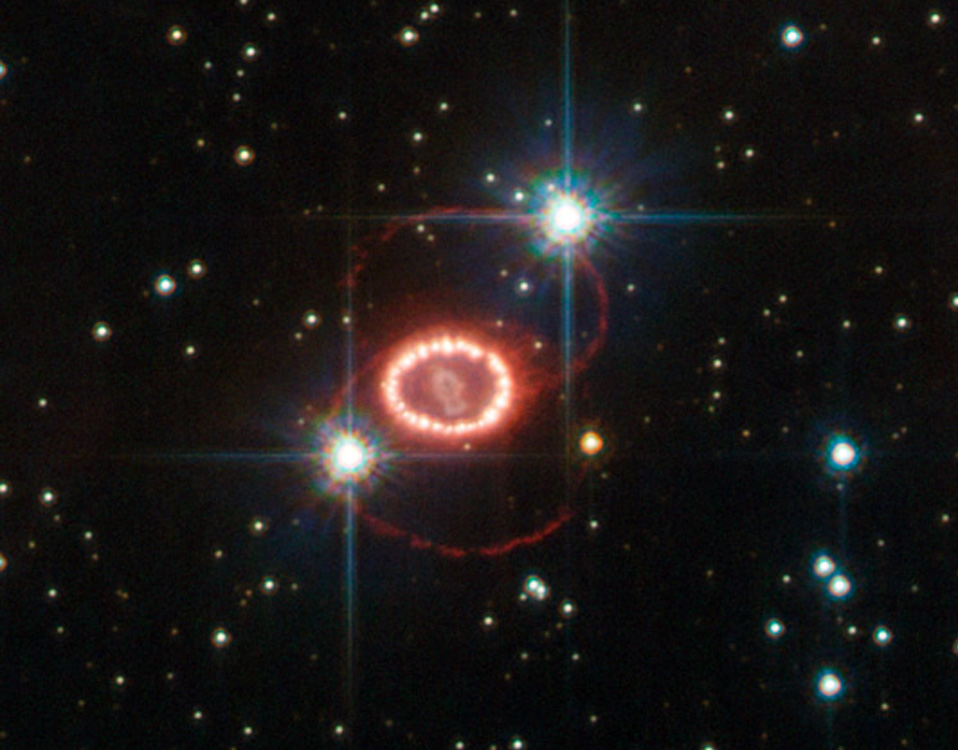
What's causing those odd rings in supernova 1987A? Twenty five years ago, in 1987, the brightest supernova in recent history was seen in the Large Magellanic Cloud. At the center of the above picture is an object central to the remains of the violent stellar explosion. Surrounding the center are curious outer rings appearing as a flattened figure 8. Although large telescopes including the Hubble Space Telescope monitor the curious rings every few years, their origin remains a mystery. Pictured above is a Hubble image of the SN1987A remnant taken last year. Speculation into the cause of the rings includes beamed jets emanating from an otherwise hidden neutron star left over from the supernova, and the interaction of the wind from the progenitor star with gas released before the explosion.