Supernova
A supernova is the explosive death of a star, during which it rapidly ejects most of its mass in a brilliant burst of light. In core‑collapse supernovae (Types Ib, Ic, II), massive stars (≥ 8 solar masses) exhaust their nuclear fuel, collapse under gravity, and explode. In Type Ia supernovae, a white dwarf in a binary system undergoes runaway fusion after accreting mass. These events deliver heavy elements into space, leave behind neutron stars or black holes, and power typical shock‑front supernova remnants.
Source: heasarc.gsfc.nasa.gov
APODs including "Supernova"
Aurora Over Iceland
21/03/2012
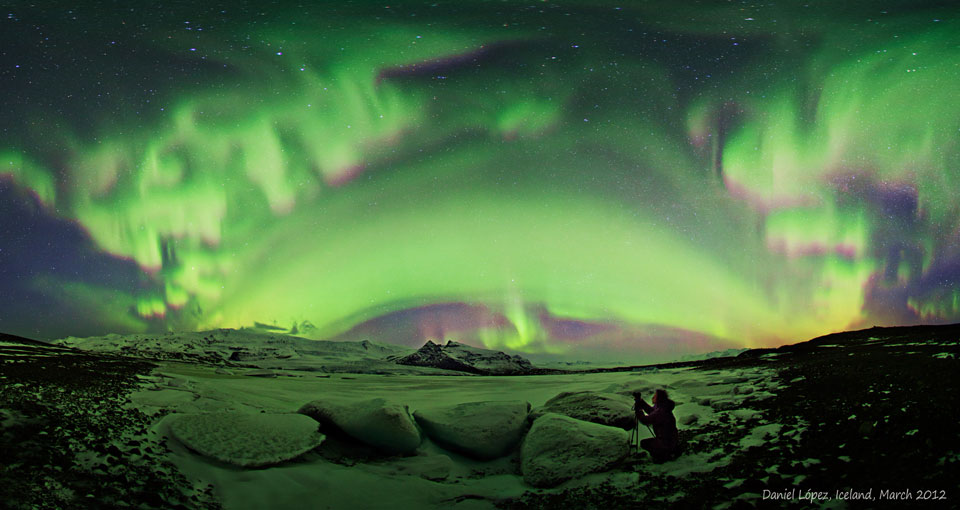
If you see a sky like this -- photograph it. Three nights ago in Iceland, an adventurous photographer (pictured) chanced across a sky full of aurora and did just that. Afterwards, by stitching together five smaller photographs, the entire aurora-lit sky was recreated in this 180-degree panorama taken from Vatnaj�kull glacier. Auroras are sparked by energetic particles from the Sun impacting the magnetic environment around the Earth. Resultant energetic particles such as electrons and protons rain down near the Earth's poles and impact the air. The impacted air molecules obtain excited electrons, and when electrons in oxygen molecules fall back to their ground state, they emit green light. Auroras are known to have many shapes and colors. News Flash -- Supernova in M95: See recent images